The Technical Committee of BISF has met and reviewed the options for bottom paint since Boaters World closed and the paint we have been using is no longer available.
In accordance with PART II BISF RULES, Section 1 – BISF Star Definition, Rule 5, the Technical Committee approved bottom paint for the upcoming season is Interlux Epoxycop (link to paint specs). This paint is hard modified-epoxy paint in compliance with DOE rules on in-water cleaning. So scrub away without the worry of John’s $10,000 fine. The paint comes in blue, black, red and green. Anyone not complying with Rule 5 will be protested by the Technical Committee and disqualified from any race that they participate in with unapproved bottom paint.
If you purchase the paint through the fleet the cost is about $70/gal (only black and blue will be available through the fleet). If you purchase it on your own it will cost approximately $100/gal. I suggest you start thinking about when you plan to get your boat ready for the season.
The following are the tentative launch dates:
First Launch - March 20, 2010
Second Launch - April 3, 2010
Third Launch - April 17, 2010
Season Champion’s Clinic – April 18, 2010
Black Star Regatta – April 23rd – 25th 2010
You need to contact Bill if you want to work in his shop and I suggest you plan early.
Friday, January 8, 2010

Wednesday, January 6, 2010
Stupid Wet Sailors
It could only happen in Olympia. That’s what I thought to myself as I huddled damply in the driver’s seat of the boat. Not a place you would want to be while the sky poured a never ending flow of water.
Not only was it freezing out on the first Monday in May, which can be expected, if not liked, but it was pouring a rain so thick that it was nearly impossible to see even a few feet in front of the boat. But none of this would have mattered to me if I was actually on a sailboat instead of huddled on a tiny motor boat with a sunshade that, instead of repelling water like it was supposed to, actually seemed to drench me more than I would have been if I was not under it. And if there had been, you know, wind.
No, the water was as smooth as glass, or, more correctly, it would have been as smooth as glass except for the rain. This was a sight that would strike fear in the hearts of sailors everywhere. Without wind, the simple fact is, there’s no sailing.
Only in Olympia would racing in these conditions take place. Only here would six stupid sailors get drenched in freezing rain in hopes of getting a few measly races off. It would be a good start to the season for them. With only three boats out, they would have a huge lead over those who weren’t so dedicated to the sport. I still couldn’t forgive them for showing up. If they hadn’t been there, I would be nice and comfortable at home where it was dry.
I couldn’t help but glower at them under my damp hair. Finally, time to go in. Soon I would be in the warmth of Tugboats, sipping hot chocolate with feeling in my hands again. Only in Olympia would people be so stupid.
Laura
Star 7094
Not only was it freezing out on the first Monday in May, which can be expected, if not liked, but it was pouring a rain so thick that it was nearly impossible to see even a few feet in front of the boat. But none of this would have mattered to me if I was actually on a sailboat instead of huddled on a tiny motor boat with a sunshade that, instead of repelling water like it was supposed to, actually seemed to drench me more than I would have been if I was not under it. And if there had been, you know, wind.
No, the water was as smooth as glass, or, more correctly, it would have been as smooth as glass except for the rain. This was a sight that would strike fear in the hearts of sailors everywhere. Without wind, the simple fact is, there’s no sailing.
Only in Olympia would racing in these conditions take place. Only here would six stupid sailors get drenched in freezing rain in hopes of getting a few measly races off. It would be a good start to the season for them. With only three boats out, they would have a huge lead over those who weren’t so dedicated to the sport. I still couldn’t forgive them for showing up. If they hadn’t been there, I would be nice and comfortable at home where it was dry.
I couldn’t help but glower at them under my damp hair. Finally, time to go in. Soon I would be in the warmth of Tugboats, sipping hot chocolate with feeling in my hands again. Only in Olympia would people be so stupid.
Laura
Star 7094
Thursday, November 26, 2009
Sailing - The Best Thing That Ever Happened
I met my wife, Joan, in New York City in the 1980’s. If it were not for sailing I’m not sure she would have dated me.
She was someone who grew up near the Puget Sound in Olympia Washington, but her family was not boat centric like mine. She was exposed to sailing on her neighbor’s boat in the 70’s and raced some on it but longed to do it more than her circumstances allowed. Taking sailing classes through a city parks program got her started but not satisfied, because she never had the chance to own a sailboat and spend as much time as she pleased on the water.
On the other hand, I grew up in Michigan in a family of boaters. We were not strictly sailors, but we had boats of every shape and size: row boats, ski boats, cabin cruisers for cruising the Great Lakes and also sailboats for racing. Fortunately for me there was a sailing club on the lake where we had a cottage. I spent my summers racing sailboats, water skiing, exploring the connecting chain of lakes in a small boat with a 3 horse engine and fishing. Life in a boat was second nature to me.
When I moved from Michigan to New York, the first thing I looked for was a sailing club, and I bought a beat up old Thistle sailboat before I had a car. I had never seen a Thistle before, but I chose it because I could afford it, and there was a strong fleet of Thistles in the sailing club I joined in Connecticut. To me it wasn’t the boat that mattered as much as the fact I could race and be on the water.
When I met Joan I had a motorcycle so that I could get out of New York to the sailing club in Connecticut. Joan was more than eager to jump on the back and come Thistle sailing with me. I’m not sure Joan would have done this if she didn’t have a strong desire to sail and get out of the city for awhile on the weekends. If you’ve never sailed in a Thistle, it is great fun, but a painful experience, with a narrow rail to sit on and diamond stays on the mast that gave her so many bruises on her legs and arms that it looked like I was abusing her. I never truly understood how much sailing meant to her until one day she told me that one of the main reasons she was attracted to me was that I was a sailor. I offered her something that she didn’t have, but wanted: sailing. If I was a little smarter I would have found a less painful boat for us to sail sooner in our relationship! But, I’m not that smart.
When we moved west to Olympia in 1990, we brought our Thistle with us across the country. But the Thistle was not the best boat for our new circumstances. We took it out once when Joan was pregnant with our first daughter, and it reminded us of why we needed to move on. Pregnant and bruised is not a good combination. We sold the Thistle, and it was the end of that era. I can honestly say that every boat we have owned since the Thistle was Joan’s doing. She just needed to be on the water, and it has been my pleasure to help make it happen. I take it for granted; she doesn’t. I’ve always had boats; she has always wanted them. It is an important part of the bond between us.
During the 90’s at Joan’s urging we bought a small runabout with a 90 horse outboard that we used to explore the South Sound. We had a radius we could go from the ramp at Boston Harbor—the distance we could travel before the kids would make us crazy. The radius was small at first and we discovered a small beach at Hope Island, a local State Park accessible only by water, where our daughters would play and eat the sand. When they got a little older we could make it as far as Lake Bay on the Key Peninsula where the kids could explore and swim in the warm, shallow tidal water. During the 90’s I would occasionally sail in the Wednesday night races with friends, and Joan would not be happy about it. I figured she was being selfish for not wanting me to sail. What I should have known was that what she wanted more than anything was to sail with me. How stupid can a guy get?
During our power boating days, we would borrow a C&C 35 from Joan’s brother for a week long summer sailing trip to the San Juan Islands. We would spend a week exploring the islands and watching for whales. This was a terrific family activity, and it got us out in a sailboat together again, reminding me of what a pleasure it was to be out on the water with the entire family for an extended period. It was like the trips in Michigan I used to take on the Great Lakes as I was growing up. But a boat of this type was not in the cards for us just yet.
In 2004 in the local paper, she read about a Star fleet that was starting on Budd Inlet. She decided it was time to get a sailboat that we could afford and race together. It was something that she wanted to do with me. I got in touch with the Fleet Captain, and he got us in contact with someone in LA who had a boat that met our needs: not too much money and the promise of not too much work to get it race ready. We took a family road trip to Southern California to pick it up in the spring of 2005. We sailed it together that summer, and I can say that it was fantastic racing with her again. She just wanted to be on the water sailing again with me. And for me it was as much about being on the water sailing with her as it was racing. As it happened, both our daughters wanted to try racing Stars with me the next year, and as a mother she wanted them to have the experience of sailing that she never had growing up. This left her on the shore without sailing again. This would never be acceptable and would lead to the next boat, something big enough for the family to sail together.
With her determination and prodding we found a Catalina 36 in Seattle that was perfect for the family to sail, but when we finally made an offer it was already sold. The disappointment was palpable and caused us to give up on the search for about year. I was working in Oregon and this was a low point for me being so far from Joan and the girls. But Joan really wanted a boat for us to sail together. For her it was as much a symbol of our relationship as it was a boat. We needed something to call our own, a sacred space where we could be totally together. Face it, she just likes being out on the water, and I’m lucky enough to be able to make that happen. We started looking again, and to our surprise the Catalina we were looking at the year before was back on the market. Apparently the new owner was transferred out of town and it was just waiting for us to be ready to buy her. After we bought it we made a vow that the boat was just for the two of us and we would never sail it without the other. When I’m out on the water with Joan I can talk more easily or not talk at all; I’m at peace.
Life without sailing for me would be desolate. The connection it gives me to my wife and daughters would be lost. But it took me along time to realize how much it meant to her. Because of her we have boats of every shape and size just like how I grew up. They represent freedom and togetherness. I’m not any good at finding meaningful gifts; I’m not much of a shopper and could never buy jewelry or a trinket that has any meaning. The one thing I can do is give her the gift of sailing, something that touches my soul, and I can share it with her. The wind, the water, and conversation on a summer day…I can’t think of anything better as long as she is with me.
She was someone who grew up near the Puget Sound in Olympia Washington, but her family was not boat centric like mine. She was exposed to sailing on her neighbor’s boat in the 70’s and raced some on it but longed to do it more than her circumstances allowed. Taking sailing classes through a city parks program got her started but not satisfied, because she never had the chance to own a sailboat and spend as much time as she pleased on the water.
On the other hand, I grew up in Michigan in a family of boaters. We were not strictly sailors, but we had boats of every shape and size: row boats, ski boats, cabin cruisers for cruising the Great Lakes and also sailboats for racing. Fortunately for me there was a sailing club on the lake where we had a cottage. I spent my summers racing sailboats, water skiing, exploring the connecting chain of lakes in a small boat with a 3 horse engine and fishing. Life in a boat was second nature to me.
When I moved from Michigan to New York, the first thing I looked for was a sailing club, and I bought a beat up old Thistle sailboat before I had a car. I had never seen a Thistle before, but I chose it because I could afford it, and there was a strong fleet of Thistles in the sailing club I joined in Connecticut. To me it wasn’t the boat that mattered as much as the fact I could race and be on the water.
When I met Joan I had a motorcycle so that I could get out of New York to the sailing club in Connecticut. Joan was more than eager to jump on the back and come Thistle sailing with me. I’m not sure Joan would have done this if she didn’t have a strong desire to sail and get out of the city for awhile on the weekends. If you’ve never sailed in a Thistle, it is great fun, but a painful experience, with a narrow rail to sit on and diamond stays on the mast that gave her so many bruises on her legs and arms that it looked like I was abusing her. I never truly understood how much sailing meant to her until one day she told me that one of the main reasons she was attracted to me was that I was a sailor. I offered her something that she didn’t have, but wanted: sailing. If I was a little smarter I would have found a less painful boat for us to sail sooner in our relationship! But, I’m not that smart.
When we moved west to Olympia in 1990, we brought our Thistle with us across the country. But the Thistle was not the best boat for our new circumstances. We took it out once when Joan was pregnant with our first daughter, and it reminded us of why we needed to move on. Pregnant and bruised is not a good combination. We sold the Thistle, and it was the end of that era. I can honestly say that every boat we have owned since the Thistle was Joan’s doing. She just needed to be on the water, and it has been my pleasure to help make it happen. I take it for granted; she doesn’t. I’ve always had boats; she has always wanted them. It is an important part of the bond between us.
During the 90’s at Joan’s urging we bought a small runabout with a 90 horse outboard that we used to explore the South Sound. We had a radius we could go from the ramp at Boston Harbor—the distance we could travel before the kids would make us crazy. The radius was small at first and we discovered a small beach at Hope Island, a local State Park accessible only by water, where our daughters would play and eat the sand. When they got a little older we could make it as far as Lake Bay on the Key Peninsula where the kids could explore and swim in the warm, shallow tidal water. During the 90’s I would occasionally sail in the Wednesday night races with friends, and Joan would not be happy about it. I figured she was being selfish for not wanting me to sail. What I should have known was that what she wanted more than anything was to sail with me. How stupid can a guy get?
During our power boating days, we would borrow a C&C 35 from Joan’s brother for a week long summer sailing trip to the San Juan Islands. We would spend a week exploring the islands and watching for whales. This was a terrific family activity, and it got us out in a sailboat together again, reminding me of what a pleasure it was to be out on the water with the entire family for an extended period. It was like the trips in Michigan I used to take on the Great Lakes as I was growing up. But a boat of this type was not in the cards for us just yet.
In 2004 in the local paper, she read about a Star fleet that was starting on Budd Inlet. She decided it was time to get a sailboat that we could afford and race together. It was something that she wanted to do with me. I got in touch with the Fleet Captain, and he got us in contact with someone in LA who had a boat that met our needs: not too much money and the promise of not too much work to get it race ready. We took a family road trip to Southern California to pick it up in the spring of 2005. We sailed it together that summer, and I can say that it was fantastic racing with her again. She just wanted to be on the water sailing again with me. And for me it was as much about being on the water sailing with her as it was racing. As it happened, both our daughters wanted to try racing Stars with me the next year, and as a mother she wanted them to have the experience of sailing that she never had growing up. This left her on the shore without sailing again. This would never be acceptable and would lead to the next boat, something big enough for the family to sail together.
With her determination and prodding we found a Catalina 36 in Seattle that was perfect for the family to sail, but when we finally made an offer it was already sold. The disappointment was palpable and caused us to give up on the search for about year. I was working in Oregon and this was a low point for me being so far from Joan and the girls. But Joan really wanted a boat for us to sail together. For her it was as much a symbol of our relationship as it was a boat. We needed something to call our own, a sacred space where we could be totally together. Face it, she just likes being out on the water, and I’m lucky enough to be able to make that happen. We started looking again, and to our surprise the Catalina we were looking at the year before was back on the market. Apparently the new owner was transferred out of town and it was just waiting for us to be ready to buy her. After we bought it we made a vow that the boat was just for the two of us and we would never sail it without the other. When I’m out on the water with Joan I can talk more easily or not talk at all; I’m at peace.
Life without sailing for me would be desolate. The connection it gives me to my wife and daughters would be lost. But it took me along time to realize how much it meant to her. Because of her we have boats of every shape and size just like how I grew up. They represent freedom and togetherness. I’m not any good at finding meaningful gifts; I’m not much of a shopper and could never buy jewelry or a trinket that has any meaning. The one thing I can do is give her the gift of sailing, something that touches my soul, and I can share it with her. The wind, the water, and conversation on a summer day…I can’t think of anything better as long as she is with me.
Wednesday, November 25, 2009
2010 Rule Changes
As you might have seen previously during our discussions on the new rules there were a few cases where the new rules didn't work. You might recall Rules 18 Scenario 4 It didn't make sense that a boat not entitled to mark room could pass head to wind at the leeward mark and turn off Rule 18.2(b). ISAF agreed and this rule was modified. I don't recall this happening in any of our races, but I'm glad they are changing it for next year. See the new wording below.
Rule 18.2(c):
(c) When a boat is required to give mark-room by rule 18.2(b), she shall continue to do so even if later an overlap is broken or a new overlap begins. However,Rule 18.2(c) will be changed to prohibit a newly discovered and potentially dangerous tactic that was an unintended consequence of the current wording of this rule. The revised rule will no longer permit a boat to tack just before she reaches a mark and, as a result of her tack, become entitled to mark-room from boats that had been clear ahead of her when they reached the zone. A parallel change in rule B3.1(c) outlaws a similar tactic in a sailboard race.if either boat passes head to wind orif the boat entitled to mark-room passes head to wind or leaves the zone, rule 18.2(b) ceases to apply.
Another issue we saw with our review of the rules was that there were problems with both Rule 18 and 19 turned on at a mark. There seemed to be too many confusing circumstances that occurred. ISAF decided to take care of this by changing the definition of obstruction. I'm not completely sure this solves the problem and I'm a bit concerned there might be unintended consequences with changing this definition. You will recall the post in September Possible Change in Rules for 2010 that presented this proposed change. We will see how this works out as it takes effect next year..
Definition Obstruction:
Obstruction An object that a boat could not pass without changing course substantially, if she were sailing directly towards it and one of her hull lengths from it. An object that can be safely passed on only one side and an area so designated by the sailing instructions are also obstructions. However, a boat racing is not an obstruction to other boats unless they are required to keep clear of her,The definition "Obstruction" will be changed so that a boat racing will no longer be an obstruction to other boats that are required to give her room or mark-room. This change will simplify the analysis of some situations near a mark in which both rules 18 and 19 apply, and it will not otherwise change the ‘game’.give her room or mark-roomor, if rule 22 applies, avoid her. A vessel under way, including a boat racing, is never a continuing obstruction.
Here are a few other rules that are changing in 2010, but they will not effect our racing as far as I can tell:
Definition Party:
Party A party to a hearing: a protestor; a protestee; a boat requesting redress or for which redress is requested by the race committee or considered by the protest committee under rule 60.3(b); a race committee acting under rule 60.2(b); a boat or competitor that may be penalized under rule 69.1; a race committee orAdditions will be made to the definition Party to correct unintended omissions. The revised definition will mean that, whenever redress is requested for a boat by the race committee or considered for a boat by the protest committee, that boat will be a party to the resulting hearing. Also, a race committee that requests redress for a boat will also become a party when its request is heard.anorganizing authority in a hearing under rule 62.1(a).
Appendix B, Rule B3.1(c):
Rule 18.2(c) is changed to:
When a board is required to give mark-room by rule 18.2(b), she shall continue to do so even if later an overlap is broken or a new overlap begins. However, ifeither boardthe board entitled to mark-room passes head to wind, rule 18.2(b) ceases to apply.
Appendix C, Rule C2.12 (a new rule):
C2.12 Rule 18.2(e) is changed to ‘If a boat obtained an inside overlap and from the time the overlap began, the outside boat has been unable to give mark-room, she is not required to give it.’
The more things change the more they stay the same.
Monday, November 23, 2009
Sailing
Sailing is a rush. When winds exceed 15 knots, our deck slants almost vertically and chop splashes over the bow and low side, drenching me, the crew sitting in the forward position. My dad and I sit next to each other on the side of our Star (a low, slick racing boat), Tantalus, ready to fling our combined weight over the side to level the deck as much as our 300 pounds can. I hook my feet into the hiking straps and lean out in a sustained sit-up for the length of the tack. Anyone who says sailing is not a real sport does not understand the meaning of work--strength, focus, and strategy combine during a race to form the ultimate recreation.
Julia
Julia
More for Less
Sailing at its best sailing gives you more pleasure for so much less. No fuel burned, no noise and nothing but the wind to push you along at sometimes amazing speeds. When you look around the landscape of possible sailing experiences no boat can compare to the Star for classic beauty and pure sailing excellence. For a new Star we get so much more for less in our fleet.
With our fleet rules limiting the boats to only old boats, used sails and the spirit of helping all comers that our Fleet Captain, Bill Brosius, demonstrates each year as he opens his shop to the fleet and helps us get our boats ready for the season.
The cost of sailing in our Star Fleet is much less than sailing Lasers.
Norm
With our fleet rules limiting the boats to only old boats, used sails and the spirit of helping all comers that our Fleet Captain, Bill Brosius, demonstrates each year as he opens his shop to the fleet and helps us get our boats ready for the season.
The cost of sailing in our Star Fleet is much less than sailing Lasers.
Norm
Saturday, November 21, 2009
Bringing Alcor Back to Life
Bill Brosius, of the Budd Inlet Star Fleet in Olympia Washington, is deeply involved with his latest Star resurrection project of Star 924 named Alcor. And I do mean resurrection, because she was a mess and left for dead when Bill found her about a year ago in a garage in Spokane. In fact, to my untrained eye it looked to me like what she needed was gasoline and a match. But, this boat is not just any boat to Bill; it is the first Star he ever fixed up and owned. He just couldn’t let her die.
Star 924 was born in 1932 in Blanchard Boat Company on Lake Union in Seattle Washington. The earliest regatta recorded for Alcor was in the 1939 Star North Americans in San Francisco when she was sailed by F. Hissock from the Puget Sound Fleet finishing 12th. She has a connection to more than just Bill in our Fleet. She was shipped from the Puget Sound to Chicago in 1949 and sailed in the Star World Championships that year. She was skippered by a Puget Sound icon Sunny Vynne and crewed by our own Vicky Sheldon’s father Robert Watt. They were sailing against other Star greats of the time like North and Lippincott. Lowell North was first or second in every race in 1949, but didn’t win the regatta due to a disqualification in one of the races. I guess even the sailing greats break a rule now and then. Vynne and Watt finished 18th in Alcor. The following are their results for the regatta:
18, 924 Alcor, E. Vynne Jr., R. Watt, Puget Sound, 14 27 14 14 26
You can read the full regatta report and see the results at the following links to the Star Class website:
http://www.starclass.org/history/1949worlds.htm
http://www.starclass.org/history/1947-worlds.htm#1946
Because of all this history, Bill couldn’t take my advice and make a bonfire of 924 at our next fleet meeting. The last time Bill had his hands on Alcor it was the early 1970’s when the boat was donated to the Sea Scouts in Tacoma. The boat was old then, and in need of repair. Bill being Bill offered to fix Alcor up for the Scouts so they could learn to sail Stars (some things never change). A few years later he purchased Alcor from the Seas Scouts and he sailed her with the Tacoma Fleet in the 70’s. Bill, wanting to upgrade to the new fangled fiberglass boats at the end of the decade, sold Alcor and she went east in about 1979 to be sailed in a feet on Lake Coeur d’Alene. When participation declined in the Lake Coeur d’Alene fleet, Alcor disappeared into a garage somewhere in Spokane Washington. She might never been sailed again if someone hadn’t purchased her at a garage sale, and thought it might be fun to fix up an old wood Star. The new owner, realizing it was more work than expected to restore her, put Alcor on Craig’s List with an asking price equal to the value of the trailer on which she sat, $200.
Bill, seeing the advertisement, decided to head to Spokane to see his old friend Alcor. She wasn’t much to look at, but as Bill told of her history the owner realized that she was worth more to Bill than to him, so he gave her to Bill with the understanding she would be restored and raced again. This was a promise Bill could easily keep. It was not a question of if she would be restored; it was only a matter of when. Finally, with all the fleet put to bed for the season, Bill has had a chance to get going on the restoration. About a year after Bill was reunited with Alcor, and 77 years after she was built, she is rising from the ashes to be sailed on Puget Sound again.
With specs from the 1971 Star Log and an original set of plans to guide each step of the restoration, what follows are the messages and pictures that Bill has sent as he has worked on this labor of love. Some of the pictures were taken by Dave Roe as he helped Bill with the restoration. Also, Jim Findley has helped on this project as his wood Star was in Bill’s shop to get a face lift, and no one can resist lending a hand when asked by Bill.
August 17, 2009
I should have the boat all rough sanded this morning and some of the smooth sanding done. I have located all the planks I need for the bottom [Port Orford cedar as specified in the specs] and I will hunt down some oak to finish making the frames I need. It’s possible I could have all the new frames and planks in place by Labor Day weekend. Bill

September 7, 2009
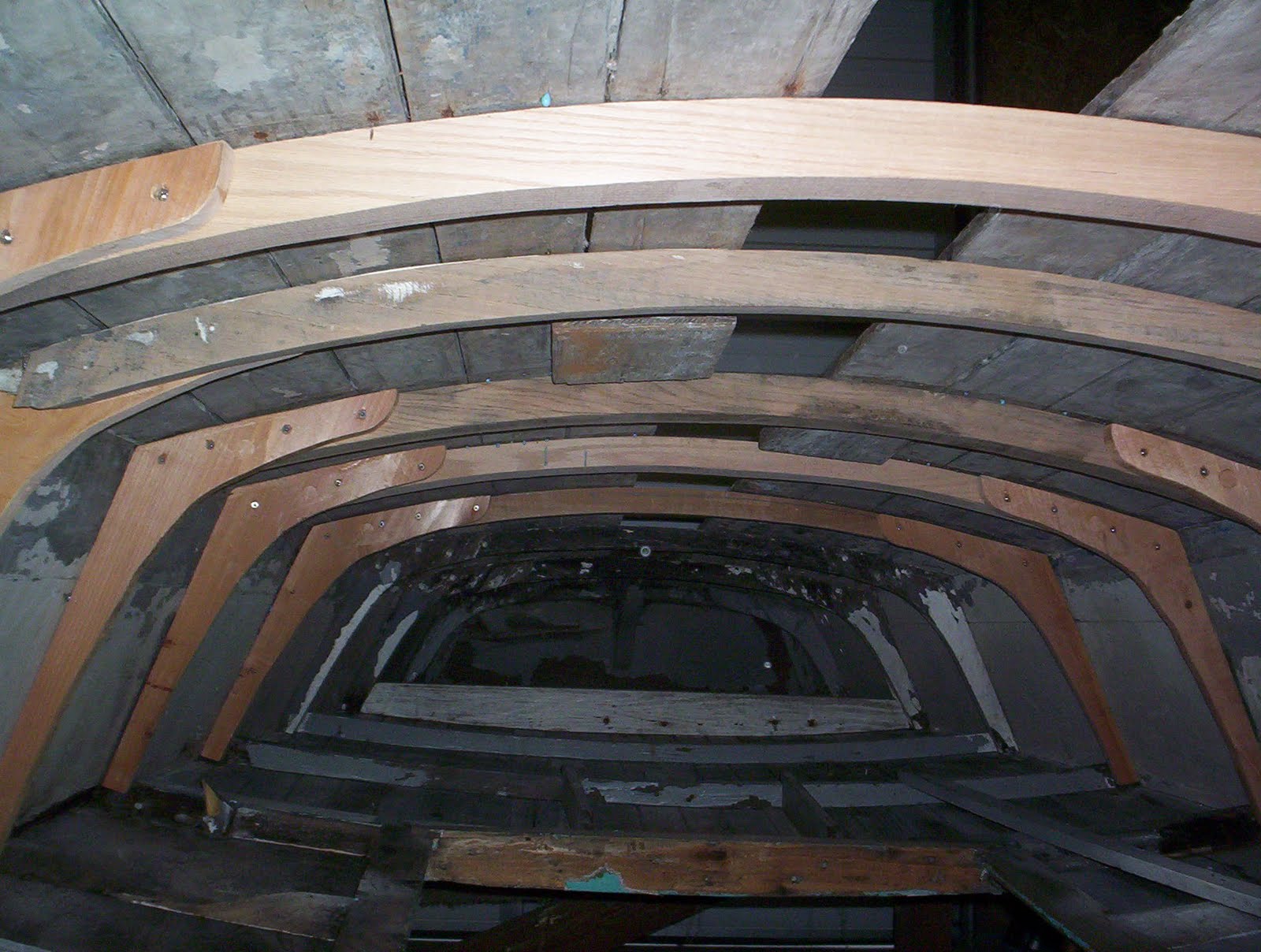
I made and installed five sets of knees and will get the wood to make the other 6 sets tomorrow. I started fairing out the dings in the wood and filled all the screw holes that I’ve uncovered so far. I will still have a bunch when I install the rest of the knees. In the morning I will sand the fairing compound and the hull with the DA, and fill any remaining spots. I will be down at the marina around noon and then go to Hardel’s for my lumber and come home to cut out the rest of the knees, which I will install Wednesday. I hope to finish cleaning out and installing all the wedges in the seams between the bottom planks that will be left in place. All I will have left to do will be to install the new bottom planks and wedge them then I will be ready to fiberglass the bottom and sides to within 2 inches of the gunnels. I will be ready to start on the deck by the beginning of October. Bill

September 13, 2009
I just finished installing the last knee piece and am now ready to start installing the bottom planks that need replacing. I picked up the planks Friday. If I can get my camera working I will take some pictures before installing the bottom planks. I probably won't start on the planks till tomorrow or Tuesday since I need to mow my lawn yet today. I will finish filling the screw holes with fairing compound so I can sand before doing the planks. Bill

September 27, 2009
I finished sanding the bottom tonight, will feather the edge of the glass I put on the bottom. Then I’ll wrap the bottom to side area and put the second layer of the bidirectional cloth at the mast step area. I will be down in the morning to bring some flowers for Hanna. See you or Dave then. Bill

October 2, 2009
I just finished flipping 924 right side up and it is sitting on some tires on the floor. Bill

November 5, 2009
A note to update you on Jim’s and my boat restoration progress. Jim's boat will be ready to put the finish varnish on his deck next Monday or Tuesday. Then he and I will start planking the deck on 924 Monday. It should be completed by next Friday and ready to finish out. I installed the new transom today and glassed the keelson. Tomorrow I will sand and fair the transom into the rest of the hull and put the two part varnish on the keelson. I will also make and install the two cockpit end pieces tomorrow or this weekend so everything will be ready for planking the deck Monday. Bill

November 11, 2009
This picture is showing the deck planked. Now it is just a matter of doing all the screws around the gunnels, plugging the screw holes, sand the edges as well as the deck and it will be ready to finish. Bill

November 18, 2009
Alcor now has a new deck and there is no doubt she will be racing with us in the spring. He has the original wood mast and boom and 1940's era sails for show, but mostly she will be raced in our fleet using the latest hardware and rigging. Thanks to all of Bill’s work on restoring these forgotten wonders, we have the largest fleet of active racing wood Stars anywhere in the world. There could be 7 boats sailing in the wood division of our fleet including: 924, 2362, 2876, 3331, 4078, 4817, and 4916. Bill tells me there could be a couple of additional wood boats out there that want to join in the fun. I have no doubt the wood division of the Budd Inlet Star Fleet will continue to grow. How could it not, when there is an opportunity to actually race these classic beauties.


For more pictures of the restoration go to the following link:
MORE PICTURES
18, 924 Alcor, E. Vynne Jr., R. Watt, Puget Sound, 14 27 14 14 26
You can read the full regatta report and see the results at the following links to the Star Class website:
http://www.starclass.org/history/1949worlds.htm
http://www.starclass.org/history/1947-worlds.htm#1946
Because of all this history, Bill couldn’t take my advice and make a bonfire of 924 at our next fleet meeting. The last time Bill had his hands on Alcor it was the early 1970’s when the boat was donated to the Sea Scouts in Tacoma. The boat was old then, and in need of repair. Bill being Bill offered to fix Alcor up for the Scouts so they could learn to sail Stars (some things never change). A few years later he purchased Alcor from the Seas Scouts and he sailed her with the Tacoma Fleet in the 70’s. Bill, wanting to upgrade to the new fangled fiberglass boats at the end of the decade, sold Alcor and she went east in about 1979 to be sailed in a feet on Lake Coeur d’Alene. When participation declined in the Lake Coeur d’Alene fleet, Alcor disappeared into a garage somewhere in Spokane Washington. She might never been sailed again if someone hadn’t purchased her at a garage sale, and thought it might be fun to fix up an old wood Star. The new owner, realizing it was more work than expected to restore her, put Alcor on Craig’s List with an asking price equal to the value of the trailer on which she sat, $200.
Bill, seeing the advertisement, decided to head to Spokane to see his old friend Alcor. She wasn’t much to look at, but as Bill told of her history the owner realized that she was worth more to Bill than to him, so he gave her to Bill with the understanding she would be restored and raced again. This was a promise Bill could easily keep. It was not a question of if she would be restored; it was only a matter of when. Finally, with all the fleet put to bed for the season, Bill has had a chance to get going on the restoration. About a year after Bill was reunited with Alcor, and 77 years after she was built, she is rising from the ashes to be sailed on Puget Sound again.
With specs from the 1971 Star Log and an original set of plans to guide each step of the restoration, what follows are the messages and pictures that Bill has sent as he has worked on this labor of love. Some of the pictures were taken by Dave Roe as he helped Bill with the restoration. Also, Jim Findley has helped on this project as his wood Star was in Bill’s shop to get a face lift, and no one can resist lending a hand when asked by Bill.
August 17, 2009
I should have the boat all rough sanded this morning and some of the smooth sanding done. I have located all the planks I need for the bottom [Port Orford cedar as specified in the specs] and I will hunt down some oak to finish making the frames I need. It’s possible I could have all the new frames and planks in place by Labor Day weekend. Bill

September 7, 2009
I made and installed five sets of knees and will get the wood to make the other 6 sets tomorrow. I started fairing out the dings in the wood and filled all the screw holes that I’ve uncovered so far. I will still have a bunch when I install the rest of the knees. In the morning I will sand the fairing compound and the hull with the DA, and fill any remaining spots. I will be down at the marina around noon and then go to Hardel’s for my lumber and come home to cut out the rest of the knees, which I will install Wednesday. I hope to finish cleaning out and installing all the wedges in the seams between the bottom planks that will be left in place. All I will have left to do will be to install the new bottom planks and wedge them then I will be ready to fiberglass the bottom and sides to within 2 inches of the gunnels. I will be ready to start on the deck by the beginning of October. Bill

September 13, 2009
I just finished installing the last knee piece and am now ready to start installing the bottom planks that need replacing. I picked up the planks Friday. If I can get my camera working I will take some pictures before installing the bottom planks. I probably won't start on the planks till tomorrow or Tuesday since I need to mow my lawn yet today. I will finish filling the screw holes with fairing compound so I can sand before doing the planks. Bill
September 27, 2009
I finished sanding the bottom tonight, will feather the edge of the glass I put on the bottom. Then I’ll wrap the bottom to side area and put the second layer of the bidirectional cloth at the mast step area. I will be down in the morning to bring some flowers for Hanna. See you or Dave then. Bill

October 2, 2009
I just finished flipping 924 right side up and it is sitting on some tires on the floor. Bill

November 5, 2009
A note to update you on Jim’s and my boat restoration progress. Jim's boat will be ready to put the finish varnish on his deck next Monday or Tuesday. Then he and I will start planking the deck on 924 Monday. It should be completed by next Friday and ready to finish out. I installed the new transom today and glassed the keelson. Tomorrow I will sand and fair the transom into the rest of the hull and put the two part varnish on the keelson. I will also make and install the two cockpit end pieces tomorrow or this weekend so everything will be ready for planking the deck Monday. Bill

This picture is showing the deck planked. Now it is just a matter of doing all the screws around the gunnels, plugging the screw holes, sand the edges as well as the deck and it will be ready to finish. Bill

November 18, 2009
Alcor now has a new deck and there is no doubt she will be racing with us in the spring. He has the original wood mast and boom and 1940's era sails for show, but mostly she will be raced in our fleet using the latest hardware and rigging. Thanks to all of Bill’s work on restoring these forgotten wonders, we have the largest fleet of active racing wood Stars anywhere in the world. There could be 7 boats sailing in the wood division of our fleet including: 924, 2362, 2876, 3331, 4078, 4817, and 4916. Bill tells me there could be a couple of additional wood boats out there that want to join in the fun. I have no doubt the wood division of the Budd Inlet Star Fleet will continue to grow. How could it not, when there is an opportunity to actually race these classic beauties.


MORE PICTURES
Sunday, November 8, 2009
Rule 17 Review
One of the limitations in the rules on the right-of-way boat is contained Rule 17, ON THE SAME TACK; PROPER COURSE, which reads as follows:
If a boat clear astern becomes overlapped within two of her hull lengths to leeward of a boat on the same tack, she shall not sail above her proper course while they remain on the same tack and overlapped within that distance, unless in doing so she promptly sails astern of the other boat. This rule does not apply if the overlap begins while the windward boat is required by rule 13 to keep clear.
This rule is in Section B of Part 2, and is put in place so that a boat on the same tack as you can’t establish an overlap to leeward from clear astern and luff you above her proper course. Remember it is the proper course of the boat that has established the overlap to leeward that matters to this rule. Another important point about this rule; if you are a boat that has been overlapped to leeward and believe that the leeward boat is sailing above her proper course, you are still required to keep clear. Your only option is to keep clear and then protest. If you don’t keep clear you will be disqualified even if it is found that the leeward boat did indeed break Rule 17.


I’ll show a couple of cases that demonstrates how the rule works. In the first case a boat on the down wind leg gets an overlap from clear astern and luffs above her proper course, she breaks Rule 17. In the second case two boats are sailing different courses because perhaps they are in a PHRF race and they are different types of boats and sail different angles down wind. In this case even though the windward boat is sailing higher than her proper course it is the proper course of the leeward boat that matters, so Rule 17 is not broken. In the third example before the starting signal you are permitted to establish an overlap to leeward from clear astern and luff head to wind because by the definition of proper course, there is no proper course before the starting signal. However, after the starting signal she needs to head down immediately or she will break Rule 17.
This is the basics of Rule 17. If you want to get more in depth you can review US Sailing Appeals: 4, 13, 43 and 70. Also take a look at ISAF Cases: 7, 13, 14 and 46. If no one protests next month I’ll look at another rule.
If a boat clear astern becomes overlapped within two of her hull lengths to leeward of a boat on the same tack, she shall not sail above her proper course while they remain on the same tack and overlapped within that distance, unless in doing so she promptly sails astern of the other boat. This rule does not apply if the overlap begins while the windward boat is required by rule 13 to keep clear.
This rule is in Section B of Part 2, and is put in place so that a boat on the same tack as you can’t establish an overlap to leeward from clear astern and luff you above her proper course. Remember it is the proper course of the boat that has established the overlap to leeward that matters to this rule. Another important point about this rule; if you are a boat that has been overlapped to leeward and believe that the leeward boat is sailing above her proper course, you are still required to keep clear. Your only option is to keep clear and then protest. If you don’t keep clear you will be disqualified even if it is found that the leeward boat did indeed break Rule 17.


I’ll show a couple of cases that demonstrates how the rule works. In the first case a boat on the down wind leg gets an overlap from clear astern and luffs above her proper course, she breaks Rule 17. In the second case two boats are sailing different courses because perhaps they are in a PHRF race and they are different types of boats and sail different angles down wind. In this case even though the windward boat is sailing higher than her proper course it is the proper course of the leeward boat that matters, so Rule 17 is not broken. In the third example before the starting signal you are permitted to establish an overlap to leeward from clear astern and luff head to wind because by the definition of proper course, there is no proper course before the starting signal. However, after the starting signal she needs to head down immediately or she will break Rule 17.
This is the basics of Rule 17. If you want to get more in depth you can review US Sailing Appeals: 4, 13, 43 and 70. Also take a look at ISAF Cases: 7, 13, 14 and 46. If no one protests next month I’ll look at another rule.
Sunday, October 25, 2009
Star Cunningham Rigging
As you might be aware Joe Downing was able to visit with Mark Reynolds who was a Gold Medalist in the Olympics in the Star class. During his visit he was able to pick up some information on how a Gold Medalist rigs the boat. You will find with this post the Reynolds Cunningham. Sherwood has written the the posted paper for your information.


Saturday, October 17, 2009
What It Should Be About
I found this story and it says it all. This is what our sport is all about. Competition without sportsmanship is meaningless.
Megan Six was also recognized by US Sailing as the sailor of the week for her Corinthian spirit.
Monday, September 7, 2009
Possible Change In Rules for 2010
As some of you might remember we ran into a bit of trouble understanding how the rules with obstructions work when the rules for mark room are in effect. I sent a query to the US Sailing rules group and I'm sure we were not the only one to do so. It appears to have resulted in an emergency change in the rules for next year. Below is a reprinted article by Rob Overton on the proposal to redefine obstruction to take care of the problem.
What do you think of this proposed change?
By Rob Overton
The Section C Working Party, consisting of Ben Altman, Chris Atkins, Dick Rose, Richard Thompson and myself, have made two submissions to ISAF that deal with rules 18 and (indirectly) 19. One is an "emergency" change in the definition of Obstruction, to go into effect January 1, 2010, and the other is a proposed ISAF Case dealing with the meaning of Room.
Before we get into the submissions themselves, let's look at the perceived problem. There are a number of scenarios in which Rule 18, Mark-Room, and Rule 19, Room to Pass an Obstruction, appear to conflict. Consider the following scenario, taken from a team-race call suggested by Matt Knowles. The boats are at a reach mark to be followed by a run:
 Black is clear ahead of both Grey and White when she enters the zone, and Grey is inside White when they the zone. Grey and White are sailing faster than Black. Grey sails to pass to leeward of Black, and White elects to sail between Grey and Black. In doing so, White forces Black to luff up. Black protests White under rule 18.2(b) for not being given mark-room, and White protests Grey under rule 19 for not giving her room to pass to leeward of Black.
White's argument is that Black is an obstruction to both Grey and White because they both owe Black mark-room (see definition 'Obstruction'). So when Grey elects to go to leeward of Black, she must give White room to do so, too. By sailing up toward White between positions 1 and 2, Grey fails to give White room, causing White to sail too close to Black and thus forcing Black above her course to the mark. White admits she broke rule 18.2(b) with respect to Black but claims she was compelled to do so. She points out that when it became clear that Grey was not going to give her room under rule 19, she could not avoid both Black and Grey. So that means Grey should be disqualified, and White exonerated under rule 64.1(c) for her breach of rule 18.2(b).
Grey sees it a different way. White is required to give mark-room to both Grey and Black, and from positions 1 through 3 that means giving them room to sail to the mark. White could easily have seen that she would not be able to go between Black and Grey and still give mark-room to both of them, so she wasn't "compelled" to break rule 18.2(b). Therefore White should not be exonerated. Grey says she herself broke no rule; she was entitled to room under rule 18.2(b) and was simply taking the room to which she was entitled.
(Note that Grey can insure she is blameless by bearing off toward the wrong side of the mark to give White room to pass between her and Black, and protesting White. Now White has clearly broken rule 18.2(b) by not giving Grey room to sail to the mark, and Grey has given room as required by rule 19.)
This apparent conflict between rules 18 and 19 is caused at least in part by the fact that Black is an obstruction to both White and Grey. This is because the definition of Obstruction says a boat racing is an obstruction only if they both "required to keep clear of her, give her room or mark-room or, if rule 22 applies, avoid her." If those words " give her room or mark-room" were removed, then White's case disappears. Black would only be an obstruction as long as both Grey and White are clear astern of her, and after that, Grey would be under no obligation to give White room to pass to leeward of Black.
This is the substance of the submission the Section C Working Party has put forward to ISAF. The definition Mark-Room would say "… However, a boat racing is not an obstruction to other boats unless they are required to keep clear of her or, if rule 22 applies, avoid her. …"
But wait; think about the following scenario:
 Under the current definition, PW is an obstruction to both PL and SW because, even though she has right of way over neither of them, they both owe her room to pass Yellow. This means that SW must give PL room to pass between her and PW. Under the proposed definition, neither PL nor PW would be obstructions to SW. SW would still be required to give PL and PW room to pass SL because SL has right of way over all those boats; but why should SW give PL room to avoid PW?
The answer is a basic principle, not explicitly stated in the Racing Rules of Sailing, but nonetheless clearly implied: It is not seamanlike to break the rules. Because SW owes PL room to pass between her and SL, and because PL cannot do that without giving room to PW, thus SW must give PL room to give PW room.
Because this is not explicit in the rules, nor in the ISAF Cases, the Section C Working Group has proposed a new ISAF Case that makes this principle explicit.
So how does this pair of submissions solve problems as in the first example above? Well, under the proposed new definition of Obstruction Black would not be an obstruction to either Grey or White, so rule 19 does not apply. End of problem.
Before making these submissions, the working group spent a lot of time thinking of scenarios where the change to the definition of Obstruction might cause problems. Despite our efforts, we could think of none. Can you think of any place on the racecourse where the words "give her room or mark-room" are necessary in the definition of Obstruction? If you can, please let me know by commenting on this blogsite or contacting any of the members of the Section C Working Party. E-mail addresses for Ben Altman, Dick Rose and I are on the US SAILING website, at http://raceadmin.ussailing.org/Rules/Committee.htm.
What do you think of this proposed change?
By Rob Overton
The Section C Working Party, consisting of Ben Altman, Chris Atkins, Dick Rose, Richard Thompson and myself, have made two submissions to ISAF that deal with rules 18 and (indirectly) 19. One is an "emergency" change in the definition of Obstruction, to go into effect January 1, 2010, and the other is a proposed ISAF Case dealing with the meaning of Room.
Before we get into the submissions themselves, let's look at the perceived problem. There are a number of scenarios in which Rule 18, Mark-Room, and Rule 19, Room to Pass an Obstruction, appear to conflict. Consider the following scenario, taken from a team-race call suggested by Matt Knowles. The boats are at a reach mark to be followed by a run:

White's argument is that Black is an obstruction to both Grey and White because they both owe Black mark-room (see definition 'Obstruction'). So when Grey elects to go to leeward of Black, she must give White room to do so, too. By sailing up toward White between positions 1 and 2, Grey fails to give White room, causing White to sail too close to Black and thus forcing Black above her course to the mark. White admits she broke rule 18.2(b) with respect to Black but claims she was compelled to do so. She points out that when it became clear that Grey was not going to give her room under rule 19, she could not avoid both Black and Grey. So that means Grey should be disqualified, and White exonerated under rule 64.1(c) for her breach of rule 18.2(b).
Grey sees it a different way. White is required to give mark-room to both Grey and Black, and from positions 1 through 3 that means giving them room to sail to the mark. White could easily have seen that she would not be able to go between Black and Grey and still give mark-room to both of them, so she wasn't "compelled" to break rule 18.2(b). Therefore White should not be exonerated. Grey says she herself broke no rule; she was entitled to room under rule 18.2(b) and was simply taking the room to which she was entitled.
(Note that Grey can insure she is blameless by bearing off toward the wrong side of the mark to give White room to pass between her and Black, and protesting White. Now White has clearly broken rule 18.2(b) by not giving Grey room to sail to the mark, and Grey has given room as required by rule 19.)
This apparent conflict between rules 18 and 19 is caused at least in part by the fact that Black is an obstruction to both White and Grey. This is because the definition of Obstruction says a boat racing is an obstruction only if they both "required to keep clear of her, give her room or mark-room or, if rule 22 applies, avoid her." If those words " give her room or mark-room" were removed, then White's case disappears. Black would only be an obstruction as long as both Grey and White are clear astern of her, and after that, Grey would be under no obligation to give White room to pass to leeward of Black.
This is the substance of the submission the Section C Working Party has put forward to ISAF. The definition Mark-Room would say "… However, a boat racing is not an obstruction to other boats unless they are required to keep clear of her or, if rule 22 applies, avoid her. …"
But wait; think about the following scenario:

The answer is a basic principle, not explicitly stated in the Racing Rules of Sailing, but nonetheless clearly implied: It is not seamanlike to break the rules. Because SW owes PL room to pass between her and SL, and because PL cannot do that without giving room to PW, thus SW must give PL room to give PW room.
Because this is not explicit in the rules, nor in the ISAF Cases, the Section C Working Group has proposed a new ISAF Case that makes this principle explicit.
So how does this pair of submissions solve problems as in the first example above? Well, under the proposed new definition of Obstruction Black would not be an obstruction to either Grey or White, so rule 19 does not apply. End of problem.
Before making these submissions, the working group spent a lot of time thinking of scenarios where the change to the definition of Obstruction might cause problems. Despite our efforts, we could think of none. Can you think of any place on the racecourse where the words "give her room or mark-room" are necessary in the definition of Obstruction? If you can, please let me know by commenting on this blogsite or contacting any of the members of the Section C Working Party. E-mail addresses for Ben Altman, Dick Rose and I are on the US SAILING website, at http://raceadmin.ussailing.org/Rules/Committee.htm.
Saturday, August 15, 2009
Living On The Edge
For those of you (the entire fleet) that chickened out last Thursday just because it was a little stormy. I thought you might need a little inspiration.
Tuesday, July 14, 2009
Interfereing With Boats Racing
I have had several comments about boats having trouble with boats that are milling around in the starting area interfering with them as they are trying to finish or have just finished. There are rules that address this. Be aware that if you are not racing and interfere with a boat that is racing, you have broken Rule 23.1 and are subject to protest and disqualification. The rule reads as follows:
23.1 If reasonably possible, a boat not racing shall not interfere with a boat that is racing.
Racing is a defined term as follows:
A boat is racing from her preparatory signal until she finishes and clears the finishing line and marks or retires, or until the race committee signals a general recall, postponement or abandonment.
The most common situation described to me is that boats that are still racing, trying to finish and clear the finish line, are being interfered with by boats milling around waiting for the next sequence to start. Rule 23.1 tells us that it doesn’t matter if you have right of way over the boat that is racing, if you are not racing and force them to alter course, you have fouled them. There is no way for you to exonerate yourself for this foul by taking a two turns penalty because that is only an option while you are racing.
Rule 64.1(d) says the penalty is as follows: “If a boat has broken a rule when not racing, her penalty shall apply to the race sailed nearest in time to that of the incident.” Therefore, if you are found to have broken Rule 23.1 you will be disqualified from the race you have just finished or the following race depending on the timing of the incident.
I suggest that we all avoid the starting area until all the boats have finished. It is rude to the competitors that are still trying to finish, it makes it difficult for the RC to spot finishers and you might be subject to disqualification by Rule 23.1. If you find yourself being interfered with by boats that are not racing as you are trying to finish, please don’t hesitate to protest.
23.1 If reasonably possible, a boat not racing shall not interfere with a boat that is racing.
Racing is a defined term as follows:
A boat is racing from her preparatory signal until she finishes and clears the finishing line and marks or retires, or until the race committee signals a general recall, postponement or abandonment.
The most common situation described to me is that boats that are still racing, trying to finish and clear the finish line, are being interfered with by boats milling around waiting for the next sequence to start. Rule 23.1 tells us that it doesn’t matter if you have right of way over the boat that is racing, if you are not racing and force them to alter course, you have fouled them. There is no way for you to exonerate yourself for this foul by taking a two turns penalty because that is only an option while you are racing.
Rule 64.1(d) says the penalty is as follows: “If a boat has broken a rule when not racing, her penalty shall apply to the race sailed nearest in time to that of the incident.” Therefore, if you are found to have broken Rule 23.1 you will be disqualified from the race you have just finished or the following race depending on the timing of the incident.
I suggest that we all avoid the starting area until all the boats have finished. It is rude to the competitors that are still trying to finish, it makes it difficult for the RC to spot finishers and you might be subject to disqualification by Rule 23.1. If you find yourself being interfered with by boats that are not racing as you are trying to finish, please don’t hesitate to protest.
Saturday, July 11, 2009
Rule 18 At The Windward Mark


There have been few questions about Rule 18 at the windward mark during our Monday races, and a bit of confusion when it turns off and on. I have been asked to explain Rule 18 at the windward mark. The rules writers have made it so that Rule 18 only applies between boats on the same tack and that when on opposite tacks the normal right of way rules of Parts A and B apply. Also, Rule 18 makes it quite difficult on those that approach the mark on the port lay line and tack at the mark. This appears to be popular in our fleet when we have a westerly and the left side of the course is favored, but it needs to be done with caution because you have very few rights and many responsibilities when you approach the windward mark on port and tack in the Zone.
The figure on the left shows Yellow on the starboard lay line and Blue 1.5 lengths below the port lay line. Let’s walk through the rules that apply during this encounter. At positions 1 and 2 Blue is port and must keep clear of Yellow. If you look at Rule 18.1 it gives 4 cases when rule 18 does not apply. The first one of these is Rule 18.1(a) which tells us that rule 18 does not apply when boats are on opposite tacks on a beat to windward. Therefore the normal right of way rules apply and Blue must keep clear.
As soon as Blue passes head to wind while she is tacking, she must keep clear of Yellow until she is on a close hauled course by Rule 13 just like anywhere else on the course. Rule 18 begins to apply as soon as Blue passes head to wind and is on the same tack with Yellow, but what section of Rule 18 applies? Because Blue tacks inside the zone Rule 18.3 applies and 18.2 does not, so Blue is not entitled to mark-room. But, she is leeward boat so she has right of way and Yellow must keep clear as windward boat. But, rule 18.3(a) limits Blue’s luffing rights because she cannot cause Yellow to sail above close hauled. In the diagram Blue breaks Rule 18.3 and fouls Yellow because Yellow was forced to sail above close hauled.
The middle diagram illustrates Rule 18.3(b). If Blue tacks inside the zone and Yellow gets a late overlap inside at the mark, then Blue must give Yellow mark-room. Yellow is entitled to luff to round the mark and Blue must keep clear. One thing Yellow must be careful of is to turn down and not sail above her proper course at the mark. This is because she has established her overlap from clear astern and Rule 17 says she must not sail above her proper course while they remain overlapped on the same tack.
The diagram on the right shows an interesting quirk in the rules. If you read the definition of mark-room it does not include room to tack unless the boat entitled to mark-room is overlapped to windward of the boat required to give it. In this case Yellow enters the zone clear ahead and to leeward of Blue. Therefore, she is entitled to mark-room but not room to tack at the mark. She must not break Rule 13 as she tacks or Rule 15 when she acquires right of way on starboard tack. So you need to be careful when you are on the port tack lay line with a boat clear astern of you on your hip. You are entitled to mark-room but it doesn’t include room to tack. Yellow can luff head to wind but better not pass head to wind or she will probably foul Blue.
Tuesday, June 2, 2009
Finishing Quiz

Facts Found:
1. When Blue enters the Zone Green and Yellow are clear astern of Blue.
2. When Green enters the Zone she is overlapped to leeward and inside of Yellow.
3. At position 1, Blue luffs head to wind to finish and tacks to port to clear the finish mark. Blue stalls and is moving slowly away from the mark on port tack.
4. If Yellow continues on a straight line course she would clear Blue’s transom by 2 feet.
5. When Green is ½ boat lengths from the mark, she luffs sharply head to wind to sail her proper course at the mark and finish.
6. Yellow responds to the luff, but is forced into Blue’s transom.
7. Yellow keeps clear of Green and both Green and Yellow clear the finish mark.
Determine the rules that apply, your conclusions and decision based on the above facts.
An interesting problem and a real situation that happened to my daughter in her last regatta of the high school sailing season. There was no protest so we will never know how it would have been decided by a PC. The following is how I would decide it, and to be frank I'm not sure it is correct:
Rules that apply: 16.1, 18.2
Conclusions:
1. When Green, the right-of-way boat and a boat entitled to mark-room, changed course she did not give Yellow room to keep clear. Green broke rule 16.1.
2. When Yellow, the right-of-way boat, changed course she did not give Blue room to keep clear. Yellow broke rule 16.1.
Decision:
1. Green is exonerated under rule 18.5(b) because she is rounding the mark on her proper course.
2. Yellow is exonerated under rule 64.1(c) because she was compelled by Greens breach of Rule 16.1 to foul Blue.
I sent this case off to higher authorities within the sailing community to get their input as to the application of the new rules and I'll share with you what they say if I get a response.
As to Dick's contention that Blue should be DSQ for a Rule 10 violation. I would suggest you look at these same facts in the middle of the line nowhere near a finish mark. When Green luffs to finish she breaks rule 16.1 by forcing Yellow into Blue. Yellow also breaks 16.1 by heading up and hitting Blue. But I would exonerate her because she was compelled to hit Blue by Green breaking Rule 16.1. Blue was minding her own business keeping clear by a good two feet if they don't change course. Even if she were not stalled there is no maneuver she could make to avoid the contact and keep clear. Therefore, I could not DSQ Blue. I would DSQ Green if it were in the middle of the line. The only thing that saves Green is the fact that there is a mark, she is entitled to mark-room and to sail her proper course at the mark, and therefore entitled to exoneration by 18.5(b) for breaking rule 16.1.
Monday, May 25, 2009

 At the starting signal both Yellow and Blue are over early, and it is an I flag start (Rule 30.1 is in play). At about 4 boat lengths Blue gybes and Yellow tacks back toward the pin end of the starting Line. When Blue reaches the Zone at position 5 Yellow is overlapped inside and to windward of Blue. At position 6 Yellow hails for "mark-room" and Blue hails "no room". At position 7 Yellow's boom hits Blue and Yellow hits the mark. Yellow files a valid protest against Blue and there is no damage or injury as a result of the contact.
What rules apply and how do you decide this case?
Intended Answer:
Rules that Apply - Rule 11 windward keep clear, Rule 14 avoid contact, Rule 31 touching a mark
Rules that don't apply at a starting mark when approaching it to start - Section C (rules 18, 19 & 20). See the preamble to Section C of the rules.
Both boats were circling back to start and were approaching the starting mark to start. Therefore, Rule 18 does not apply to the mark, Yellow is not entitled to mark-room and must keep clear of Blue by Rule 11 (windward boat keep clear). Blue does not change course so Rule 16 does not come into play. Yellow also breaks Rule 31 by hitting the mark, and both Break Rule 14 for not avoiding contact.
DSQ Yellow for breaking Rules, 11, 31 and 14. Blue is not penalized for breaking Rule 14 by Rule 14(b) because there is no damage or injury.
As for exonerating Yellow for breaking Rule 31 for being compelled to hit the mark by Blues breach of Rule 14. I don't see this as Dick does. Yellow would have missed the mark if she had gone on the wrong side and stayed clear of Blue, so it does not look to me that she was compelled to hit the mark by any action of Blue. I do agree that Blue might have been better off avoiding the contact and then protesting, because if there was damage she would be DSQ also.
The question of how many circles one must do for braking more than one Rule. The guideline by US sailing is that it is one penalty per incident regardless on the number of rules broken if breaking the other rules was an inevitable consequence from the incident. I've attached the US Sailing Appeal 65 that addresses this and it explains the principal far better than I can. I find no similar ISAF Case so I do not know how this is defined in other jurisdictions.
Sunday, May 17, 2009
Starting Quiz


Using the diagram above, and assuming none of the Rule 30 penalties apply, answer the following:
1. Assuming that the starting guns sounds when Yellow, Blue and Green are at position 1, which boat(s) have started properly?
2. Answer the same question if the starting gun sounds when all three boats are at position 2.
The intended answers are:
1. All three boats meet the definition of starting, however, blue does not sail the course as required in Rule 28.1 Sailing The Course. Blue's string when pulled taught does not pass on the required side of the starting mark after she starts. Green's string loops around the starting mark and it does pass it on the required side as well as the wrong side, but there is no restriction on the string passing on the wrong side as long as it also passes on the correct side. I've attached Case 90 that explains it better than I can. Yellow of course starts properly and complies with Rule 28.1
2. If the gun sounds at position 2 for all three boats only Yellow will meet the definition of Starting. Both Blue and Green fail to be on the pre-start side of the line at or after the starting signal and cross the starting line. Yellow is on the pre-start side after the starting signal and crosses the line so Yellow is the only one that starts if the gun sounds at position 2.
Sunday, May 3, 2009
BSR Protest 23 vs. 14
 Below is the decision from the protest committee for the protest in race 3 of the Black Star Regatta for your information.
Facts Found:
1. Bow #14 (Yellow) rounded the windward mark clear ahead of Bow #23 (Blue).
2. #23 overtook #14 between the windward and offset mark and became overlapped to leeward of #14.
3. As #14 rounded the offset mark there was no room between #14 and the offset mark for #23 to pass the mark.
4. #23 hit the offset mark and did not take a penalty.
Rules that apply: 11, 12, 18, 31 and 44
Conclusions:
1. There is reasonable doubt that #23 established an overlap before #14 reached the zone. Therefore by Rule 18.2 (d) it is presumed that she did not.
2. #23, clear astern when #14 reached the zone, did not give #14 mark-room to sail her proper course at the mark. #23 broke rule 18.2(b).
3. #23 hit the offset mark and broke Rule 31 but did not exonerate herself as allowed by Rule 44.
4. As #14 rounds the offset mark to her proper course, as windward boat she did not keep clear of #23 and broke Rule 11.
Decision:
By Rule 64.1(a) #23 is DSQ from Race 3 of the Black Star Regatta for breaking Rules 18.2(b) and 31. #14 is exonerated for breaking Rule 11 by Rule 18.5(b).
Saturday, April 18, 2009
Season Champion's Clinic
Today was a glorious day to be out on the water. Derek DeCouteau, last year's season champion, walked us through how he sets up the boat in the various wind conditions. One of the things I like about our fleet is that if you have a question about the boat all you need to do is ask. If you got nothing else from his talk, remember to use the lower back stay as a throttle in the light to medium wind we sail in on Budd Inlet. Pull it on to power up and ease it to de-power, but don't forget to get it off as you head down wind or you'll join our order of the mangled mast. Joseph Donnette helped with the demonstrations of the various controls by setting up his boat at the dock.
We had a large group for the shore talk. So many in fact, the floating dock at Westbay Marina was at the limit with the water near the top of the dock. I think Derek's advice was good to look at the Tuning Guides for North and Quantum and the technical articles on the Star web site. these are links to the various sites where the information can be found.
After the shore talk 12 boats went out in ideal conditions for a sailing clinic. The winds were about 4 knots from the north, with occasional puffs up to 6 knots. Perfect for trying out our lower back stay throttles. Derek and Bill put us through down speed tacking and gybing drills, and it was a bit like herding cats trying to get us all in line for the start of the tacking drills, but they got it done.
Thank you Derek for putting this on for us. I know it will help us all as we get ready for the Black Star Regatta next week. Those of you that didn't make it to the clinic, watch out!!!
We had a large group for the shore talk. So many in fact, the floating dock at Westbay Marina was at the limit with the water near the top of the dock. I think Derek's advice was good to look at the Tuning Guides for North and Quantum and the technical articles on the Star web site. these are links to the various sites where the information can be found.
After the shore talk 12 boats went out in ideal conditions for a sailing clinic. The winds were about 4 knots from the north, with occasional puffs up to 6 knots. Perfect for trying out our lower back stay throttles. Derek and Bill put us through down speed tacking and gybing drills, and it was a bit like herding cats trying to get us all in line for the start of the tacking drills, but they got it done.
Thank you Derek for putting this on for us. I know it will help us all as we get ready for the Black Star Regatta next week. Those of you that didn't make it to the clinic, watch out!!!
Tuesday, April 7, 2009
Fun Scenario 2

What do you think of this one.
The Intended answers from US Sailing are:
1. Yellow breaks Rule 10.
2. Blue breaks no rule
3. Yellow is not exonerated for breaking Rule 10 because she does not do her turns in accordance with Rule 44.2.
The explanation given by US Sailing is that Yellow must first get well clear and then do two uninterrupted turns. If this were to occur in one of our races I do not believe I would be compelled to protest Yellow unless there was some sort of advantage gained. In the scenario shown I see no advantage to Yellow. It is not always easy to anticipate what others are going to do in a race and as the boat doing the turns you are required to keep clear of others and if that obligation requires you to sail clear I'm satisfied if you interrupt the turns to keep clear. If the turns were done as shown in the absence of other boats then I would protest.
Subscribe to:
Posts (Atom)