Sunday, July 25, 2010

Showtime vs. Sugar Magnolia


South Sound Sailing Society - First Wednesday Series Race 3 on June 16, 2010. Leeward mark at the end of the second lap.

Facts Found:
1. Wind was from Southwest at 5-8 knots.
2. The leeward mark was the RC boat to be left to port.
3. Showtime is an Olsen 25, 25 feet long and Sugar Magnolia is an S2 7.9, 26 feet long.
4. Sugar Magnolia reached the zone first, inside Showtime and on starboard tack; Showtime was on port tack (position 1).
5. Sugar Magnolia gybed to port tack and was sailing lower and slower than Showtime. Sugar Magnolia was sailing at approximately 3 knots and Showtime was sailing at approximately 4 knots approaching the leeward mark (position 3).
6. Sugar Magnolia was approximately 5 feet from the RC as she passed the stern of the RC boat and Showtime was approximately 10 feet to leeward of Sugar Magnolia (position 4).
7. After Sugar Magnolia passed the stern of the committee she rounded up to just below close hauled and her sails were not completely set for a close hauled course (position 5).
8. Showtime rounded up to close hauled and was on a converging course with Sugar Magnolia and she hailed Sugar Magnolia to come up (position 5 to 6).
9. Approximately 15-20 seconds after Sugar Magnolia passed the stern of the RC boat and at approximately 2 boat lengths from the mark, Sugar Magnolia headed up to close hauled and her stern struck the side of Showtime (position 6).
10. There was damage to Showtime at the point of contact.

Rules that apply:
Rule 11, On the Same Tack, Overlapped; Rule 14, Avoiding Contact; Rule 16, Changing Course; and Rule 18.2, Giving Mark Room; Applicable case, ISAF Case 25.

Conclusions:
1. By rule 18.2 Sugar Magnolia was entitled to mark-room. Based on the distance between Sugar Magnolia and the stern of the RC and between Showtime and Sugar Magnolia, adequate space was provided for a seaman like rounding in the prevailing conditions. Therefore, Showtime fulfilled her obligation to provide mark-room.
2. After passing the mark and Showtime changed course to close hauled the boats traveled approximately 2 boat lengths in 15-20 seconds as the gap between the boats was reduced from approximately 10 feet to 1 foot. Therefore, Showtime provided adequate room for Sugar Magnolia to keep clear in accordance with rule 16.
3. Sugar Magnolia as the windward boat did not keep clear as required by rule 11.
4. It was reasonably possible for Sugar Magnolia to have avoided contact if she would have responded sooner to Showtime’s change in course to close hauled.
5. It was reasonably possible for Showtime to have avoided contact if she would have born away when it was clear that Sugar Magnolia was not keeping clear.

Decision:
Sugar Magnolia broke rules 11 and 14 and is disqualified from Race 3 in the First Wednesday Series in accordance with rule 64.1(a).

Showtime broke rule 14, and because there was damage, is disqualified from Race 3 in the First Wednesday Series in accordance with rule 64.1(a).

Protest committee – Norman Smit, Don Waterhouse and Bill Sheldon

The Protest was appealed and it is pending a decision. The following is the appeal submitted to US Sailing by Sugar Magnolia.

I wish to appeal the decision in the Protest Sugar Magnolia vs. Showtime South Sound Sailing Society ­First Wednesday Series Race 3 on June 16, 2010. Leeward mark at the end of the second lap.
I am appealing because the protest committee did not apply rule 18 correctly.

You can see from their findings that the protest committee seems to mistakenly believe the outside boat’s obligation to allow inside mark room ends at the stern of the mark boat. The committee found (italics added): “1. By rule 18.2 Sugar Magnolia was entitled to mark­room. Based on the distance between Sugar Magnolia and the stern of the RC and between Showtime and Sugar Magnolia, adequate space was provided for a seaman like rounding in the prevailing conditions. Therefore, Showtime fulfilled her obligation to provide mark­room. ”

That satisfies only half of Showtime’s obligation, giving room to sail to the mark. The committee seems unaware that mark room is not only room to sail to the mark, but also room to sail one’s proper course at the mark (the definition of mark room). To determine if rule 18 was violated we also need to know, Was Sugar Magnolia given room to sail her proper course at the mark?

However the committee does not address this question. This is clearly a mistake. No one can know that rule 18 was satisfied if they do not know if the inside boat was allowed to sail her proper course at the mark. The committee’s failure to address this pivotal question led them to misapply rule 18 and judge the protest on rules that did not govern.

While the committee made no formal pronouncement as to whether the boats were at the mark or whether Sugar Magnolia was or was not sailing her proper course, their findings of fact do give us answers. Their findings show that Sugar Magnolia was sailing her proper course at the mark
.
The diagram clearly shows that both boats were in the zone at the time of contact. The finding of facts tells us they were two lengths from the mark. ISAF Case 2 tells us “Rule 18.2(a) applies … while boats are overlapped and at least one of them is in the zone.”. So rule 18 applied as they were “at the mark”.

That leaves the question, was Sugar Magnolia sailing her proper course? ISAF Case 25 tells us what the proper course for a boat at a leeward mark is, in italics which I added (as well as outside’s obligations for the rounding). “Rule 18.2(b) required OL to give IW room to sail to the mark and then room to sail her proper course while at the mark. Clearly, between positions 1 and 2 OL gave IW room to sail to the mark. At position 2, IW was ‘at the mark’ and between positions 2 and 3 she was entitled to room to sail her proper course. Her proper course during that time was to luff onto a close­hauled course, ...”

The committee found that Sugar Magnolia did luff up to closehauled. They tell us she went from beam reaching at the stern of the mark boat to close hauled in 15­20 seconds and two lengths. That is her proper course as defined in Case 25.

The committee found:
“7. After Sugar Magnolia passed the stern of the committee she rounded up to just below  close hauled …” [Bow down when slow. It is her proper course that governs.]

“9. Approximately 15­ 20 seconds after Sugar Magnolia passed the stern of the RC boat and at approximately 2 boat lengths from the mark, Sugar Magnolia headed up to close hauled …”

Look at the diagram provided by this protest committee. You see the classic “U” turn around the mark: a course to round as fast as possible (only the mark is too close to the bottom of the turn). That is her proper course.

Clearly Sugar Magnolia was sailing her proper course at the mark, as was her right under rule 18. The collision demonstrates that Showtime did not give her room at the mark, in violation of rule 18.

Sugar Magnolia was exercising her rights under rule 18, and so did not violate rule 11.

As Sugar Magnolia was fouled, her obligation under rule 14 was different than the committee thought. As a boat required to keep clear under rule 11, she would have been required to take action well before the collision was immanent. As a boat with a right to sail her proper course under rule 18 and doing so, she is not required to take action to avoid a collision until it is apparent that the fouling boat was not going to. This means she had considerably less time to take avoiding action than the committee credited her with.

The committee found:

“2. After passing the mark and Showtime changed course to close hauled the boats traveled approximately 2 boat lengths in 15­ 20 seconds as the gap between the boats was reduced from approximately 10 feet to 1 foot. Therefore, Showtime provided adequate room for Sugar Magnolia to keep clear in accordance with rule 16. …

4. It was reasonably possible for Sugar Magnolia to have avoided contact if she would have responded sooner to Showtime’s change in course to close hauled.”

This clearly assumes that Sugar Magnolia was obligated to take action when Showtime first changed course, which we now know was not the case. They say her mistake was in not taking action earlier than, we now know, she was required to. The implication of point 4 is that once it became apparent that a collision was immanent, at the point she was required to act, it was too late for Sugar Magnolia to have avoided it.
The committee’s findings of fact show that Sugar Magnolia was trying to avoid the collision, by turning to weather, away from Showtime. One is only required to make a reasonable attempt to avoid the collision; turning away from a boat charging at one is a reasonable attempt.

Showtime should be found in violation of rule 18 Sugar Magnolia should be exonerated and reinstated.
Case 25 is an example of a boat sailing below her proper course.

Note:
1.the importance of the fact that she was sailing below her proper course. That was the first issue addressed, as the out come would have been different had she been on her proper course.

2. Sugar Magnolia sailed a very different course than the boat in Case 25. This is obvious by comparing the diagrams. Two lengths from the mark the boat in Case 25 had not come up even 30 degrees; at two lengths Sugar Magnolia was closehauled and on her proper course.

How do you think this will be decided by the appeals committee?  Did the PC not properly interpret rule 18? I've attached Case 25 which was referenced in both the decision and the appeal.


Sunday, June 20, 2010

2010 High School Sailing

This years high school sailing team had a great time on and off the race course.  This is a little slide show of pictures taken throughout the season.  The music is chosen by Laura.

Thursday, June 3, 2010

Elentari vs. Puffin

On June 1, 2010, we had another arbitration hearing. This time between Elentari (#18) and Puffin (#35) in the second race, at the leeward mark. The Arbitrators were Bill Sheldon and Joe Downing.

Facts found:
1. The wind was 4 to 6 knots out of the southeast
2. Puffin was on port tack and Elentari was on starboard tack approaching the RC boat which was the leeward mark to be left to port.
3. Puffin was sailing a course toward the mark at approximately 90 degrees to the course of Elentari and Elentari was heading dead down wind by the committee boat.
4. Puffin reached the zone first and was approximately ½ to ¾ boat lengths ahead of Elentari at the mark.
5. Elentari gybed to round the mark and could not sail her proper course at the mark as Puffin rounds close to the committee boat and there is not space for Elentari to round inside at the mark.
6. To avoid contact Elentari ducked Puffin’s stern and rounded behind and to leeward of Puffin.

Rules that apply:
Rule 18.2, Giving Mark Room

Conclusions:
Puffin did not give Elentari mark-room as required by rule 18.2(b) and is assessed a 30% penalty per SI 11.4c in the second race on June 1, 2010.

Because Elentari and Puffin were sailing courses that were approximately 90 degrees form each other as shown in the diagram, Puffin owes mark-room by rule 18.2(b) to everyone on the right side of the course.  The only question is can they get there in time for it to matter.  There are two parts to the definition of mark-room. The first part is room to sail to the mark, and the second part is room to sail her proper course while at the mark. Puffin did not prevent Elentari from sailing to the mark, however, because Puffin did not provide space for Elentari to sail her proper course while at the mark  she did not provide mark-room as required in rule 18.2.  At position 3 in the diagram Elentari’s proper course is to gybe and to sail by the mark.  If Elentari were to have done this, she would have hit puffin at the chain plates and perhaps cause some serious damage. Her only course of action was to duck Puffin’s stern and protest.

What Puffin could have done is not sail as close to the mark as she rounded and allowed room for Elentari to sail her proper course at the mark. How much space is enough space depends on the conditions. In the light conditions in this case I would say 2 widths of a Star is adequate for Elentari to do a seaman like rounding.  In more wind and seas it would be more space than that, and In a blow you want enough space to avoid the mast as it comes down after her gybe; especially if you’re giving mark-room to those of us in the order of the mangled mast.

Monday, May 31, 2010

Crew Race Proposal

Dave B. has made a proposal that we have a designated crew race each night to give race time to those practicing for the Barbara Stuart Memorial, and to help developing the skippering skills of the crews that sail with us.  I would suggest we change the SIs to accommodate this in our racing and score it separately.

I propose we change Section 5 of our sailing instructions to read as follows:

5. DIVISIONS
The Fleet may be scored in the Wood Division if they are sailing in a wood Star. The Divisions might be designated using color flags. If attendance warrants, the Divisions may be started separately. When sailing as a combined fleet the overall finishing place will be used in the scoring for both Divisions. A race on any night may be designated as a Crew Race where the crew will race as skipper. The Crew Race will be signaled with a yellow flag flown before and during the starting sequence.  The crew race will not be included in the night or season scoring for a boat and will be scored under the name of the crew. The crew races for the season will be scored as the Season Championship Series is scored. If the crew of a boat is not participating in the designated crew race they will notify the RC and not be scored.


This proposal is intended to encourage more participation and leaning to race in our fleet without the pressure of jumping into the boat and sailing with the more experienced sailors without impacting the score of a boat.  If you have any other suggestions please comment. Laura* says she would like to learn to skipper a Star in this way and would make it easier to give it a try. I would like to get your input so please leave a comment and indicate your bow number,  name with the comment.

*A note from Laura: This is actually a comment sanctioned by me. If you happen to get an email or any sort of message from my dad mentioning me, it is very likely that he was using my name liberally and without my permission. Don't hold comments like these against me. It's all him.(ex. boat numbers)

Sunday, May 30, 2010

Starlight vs. Bow #23

Another week and we had another arbitration hearing this time between Joe and Joseph in the 2nd race of Spring Series 2 Night 2. The arbitrator was Norm Smit.

Facts found:
1. Wind was 5-8 knots from the south.
2. On the first down wind leg of race 2 on May 24th, Starlight was on starboard tack approaching Bow #23 on a converging course.
3. At between 4 and 5 lengths from the leeward mark, which was to be rounded to starboard, Bow #15 had to alter course to avoid contact with Bow #23 amidships
4. Bow #23 did not alter course to keep clear of Starlight.

Rules that apply:
Rule 10, On Opposite Tacks; Rule 18, Mark Room.

Conclusions:
Rule 18 did not apply per rule 18.1 because the incident took place before at least one of them reached the zone.  Bow #23 did not keep clear as required by rule 10.

Decision:
By SI 11.4c Bow #23 is assessed a 30% penalty in race 2 on May 24th

This is a case where it must be determined if the boats were at the zone.  Clearly Starlight is entitled as right of way boat to sail her course as she pleases if they are both outside the zone.  If they are on opposite tacks outside the zone, there is no limitation requiring starboard to sail directly to the mark and give mark-room until one of them reaches the zone. Because of rule10, port must keep clear even if it means she is forced to sail further from the mark than she would like. Bow #23 would have been better served to gybe and keep clear.  She could have worked to maintain her inside overlap at the zone when they gybed back toward the mark.  This would have been a better play even if she felt they were at the zone. I suggest when you are burdened boat, when there is a doubt keep clear, don’t force the right of way boat to alter course.

By the way I think everyone should give their boat a name and send them to me.  I like writing these summaries with boat names rather than bow numbers. I don’t have names for Bow numbers 2, 19, 23, 24, 26, 30, 32 and 34.

Sunday, May 23, 2010

High School Team Racing

If you want to see some high school team racing.  The Backer Trophy high school national championship was contested at Sand Point in Seattle this last weekend and this was probably one of the best races of the regatta.

Sailing Videos on Sailgroove

Alcor vs. Corvus

We had our first arbitration hearing at Tugboats after the racing on Monday May 17th. The arbitration panel was Norm Smit and Bill Sheldon. If you look at the sailing instructions for this year Section 11 on Protests has been modified. Go to the SSSS Star Web page to see the full text regarding arbitration.

There were two protests Corvus protested Alcor and Alcor protested Corvus for two separate incidences on the course. The Corvus protest was heard first. When asked if Corvus hailed protest to Alcor at the first reasonable opportunity the answer from Corvus was no. Therefore, the Protestee was not informed in accordance with 61.1(a), so the protest was not deemed valid and was not heard. Next was the Alcor protest. It was found that Alcor did indeed hail protest and informed the RC of her intent to protest as required in the sailing instructions, so her protest was deemed valid and was heard. This is an important requirement of the rules that the word PROTEST is hailed. I recommend that this is the only thing you say when you believe someone has fouled you. This way if it goes to a hearing it will be a valid protest provided you inform the RC after that race as required in our sailing instructions.

For the protest of Alcor vs. Corvus the following facts were found.

1. The wind was from the west at about 15 knots
2. Alcor was approaching the windward mark on port tack and Corvus was approaching on starboard tack just above the starboard lay line (position 1).
3. Alcor tacked inside the zone in front of Corvus. After her tack was complete Corvus luffed to avoid Alcor’s stern, but not above close hauled (position 2).
4. Courvus remained overlapped to windward as they approached the mark (position 3).
5. Alcor rounded the mark wide leaving about a half boat length between her and the mark. Corvus ducked Alcor’s stern and established a late overlap between Alcor and the mark (position 4).
6. Alcor could not sail her proper course by the mark and had to haul in her main to avoid contact between her boom and the shroud of Corvus. Alcor hailed protest (position 5) for not giving mark-room.


The rules that apply:

When the boats are on opposite tacks at the windward mark rule 10, Opposite Tacks, applies and rule 18, Mark Room, does not apply by rule 18.1(a). Therefore, Alcor is required to keep clear and is not entitled to mark-room. As Alcor passes head to wind she must keep clear of Corvus until she is on a close hauled course by rule 13, While Tacking, and once her tack is complete she must provide room for Corvus to keep clear by rule 15, Acquiring Right of Way.

After Alcor completes her tack Corvus must keep clear by rule 12, On the Same Tack not overlapped, and after she becomes overlapped to windward she must keep clear by rule 11, On the Same Tack Overlapped. Because Corvus obtained her overlap to leeward at position 4 from clear astern, she must not sail above her proper course by rule 17, On the Same Tack; Proper Course, while they remain on the same tack and overlapped .

Because Alcor was subject to rule 13 in the zone, and Corvus was “fetching” the mark rule 18.3 applies and 18.2 does not apply. Rule 18.3 requires the boat that tacks in the zone to not cause the other boat to sail above close hauled, and she must give mark-room to the other boat if she becomes overlapped inside her.

Conclusions based on the facts found:

Alcor completed her tack inside the zone in compliance with rules 13 and 15 and Corvus complied with rules 12 and 11 after the tack was completed by keeping clear. When Corvus became overlapped inside at the mark Alcor provided mark-room by sheeting in her main and avoiding contact as required in rule 18.3. Corvus did not sail above her proper course and complied with rule 17. Therefore, the protest was disallowed.

As you can see this one incident at the windward mark encompassed just about every rule in the book and the entire event probably took at most 10 to 15 seconds. An important side note, which was a point of discussion during the arbitration hearing; if the fact had been found that Alcor tacked outside the zone, then Corvus would have been penalized for not giving mark-room as required by rule 18.2, Giving Mark-Room. So it is important to have a clear understanding of where you are tacking when approaching the windward mark.

Friday, May 7, 2010

My Starboat Sail

This was sent to me by Sherwood. Mac Hancock went for a ride with Eric Egge on Stella and wrote the following note

My Star boat sail was just wonderful. It was about 3:45 in the afternoon. The day was bright and sunny. Air was maybe 65 or so. When we pushed off there was practically no air movement in the marina (West Bay), but we put up the sails and kind of sailed/sculled out of the marina and into lower Budd Inlet. The masthead fly indicated air movement out of the south so we set up on a kind of east bound reach. There was no indication of air movement at all on the water surface, but as I glanced at the water, by noticing stuff floating just below the surface I could see that we were moving right along, maybe two knots or so. It was amazing. In short order an afternoon breeze came up and we just moved out at a wonderful clip. At times the breeze may have been 8 to 10 kts in little gusts and the boat almost instantly shot forward. I had on my Polaroid sunglasses and as I looked at the masthead the sail with it's red star was a brilliant white and the blue sky was so polarized that it literally looked black when juxtaposed with the whiteness of the sail. That's the upside of the event. A star is a very powerful and brilliant performer.

Then there're the "other" aspects which I lump into two categories:

Complexity:
1. The mast is controlled by several mechanisms. It can be physically ratcheted fore and aft on a track using a lever mechanism. It can be bent using the vang. It can be bent by using the primary running backstay. It can be bent by using the secondary running backstay. It can be bent using the cunningham. The effect on sail draft is instantly visible from the cockpit and the range of draft is considerable; more than I've ever experienced in any other sailboat. The effect of sail draft is also instantly felt in the tiller and the ability to keep the boat on it's best angle of heel. This doesn't take into account the adjustments available for "tuning" all manner of other mechanisms like the vang, the cunningham, the location of the jib fairleads, the hiking straps and much more. Adjustment lines are all over the place.

2. The boat is the most uncomfortable, anti-ergonomic device that was ever invented to float. The boom sweeps across at about 8" above the deck/cockpit. There is a rigid post in the center of the cockpit atop which is the main-sheet blocks/cleat. This post divides the cockpit neatly in half. The helmsman occupies the aft half and the crewman the forward. In order to tack it's necessary to crouch down into the cockpit so low that visibility of the water around the boat is completely lost for a moment. Getting my old frame into such a crouch is possible but I don't do it as rapidly as racing conditions would call for. As helmsman one is obliged to call out the tack, begin to turn, wait in an upright position long enough to be confident that the windward backstay(s) are unloaded, release them (at which point they're pulled forward by bungees under the deck), duck into the cockpit crouch, continue steering (blind) for a bit whilst the boom passes overhead, arise as quickly as the boom allows in order draw the erstwhile leeward running backstay(s) into taught position before the wind loads the mast on the new tack and finally to continue the turn onto the new tack, stopping it without going unnecessarily far beyond closehauled.

It is a magnificent thing to sail, but the insistent, continuous physicality is way beyond what I'm interested in doing. I suppose that speaking personally there's a parallel between Star sailing and flying. I just love to fly low and slow in a small plane. However piloting an airplane demands constant attention to the operation of the plane; especially when flying low. The level of attention, even after becoming a skilled pilot, detracts markedly from what I find so enchanting about flying ... the ability to look out and observe the earth from that vantage point.

Anyhow, after Eric and I got the boat buttoned up, we went upstairs to Tugboat Annie's and had an excellent beer and burger which was a delightful way to end a great afternoon sailing.

That was my Starboat sail.

Ciao,
mac

Monday, March 29, 2010

More Alcor

Those of you that were at the first launch saw Alcor find her way into the water for the first time in some 30 years.  I've sent the Alcor story on to the Star Class and in the process found a few bits of her history. Scott Rohrer, who is familiar with the boat and had crewed on her sent a few messages that I thought I would pass on.

Scott -

I got this from the Budd Inlet Star fleet in Olympia. It mentions that Star 924, Alcor, was sailed in 1939 at the NAs in San Francisco by F. Hissock. You probably remember Sally Hiscock who went to St. Nick with me and did a lot of sailing - ended up marrying Cappy Clarke who had a Lightning (long divorced) . Her father was Frank Hiscock. I'm wondering if they are the same. I think he was a SYC member.

Perhaps you recognize others in this story, too.

Best,
Melinda
Alcor is the leading boat - photo from 1939


Wow. Alcor.  That's something.  Sure, Frank was Sally's dad but I knew nothing about his Star history.  Cappy is still a member at SYC and sends me notes about my history column from time-to-time.  I lost track of Sally but remember her as fun, bright and cheerful. A couple of things;  Some accounts of the '48 silver stars report that Sunny sailed Alcor in the practice race on Lk. Washington and won it by a mile.  Question is, did Frank own her then or did he charter her from Sunny for the '49 gold stars? 
 
The most frequently-told Alcor tale here is about the time Sunny sank her during a fall race over by Medina.  She sat on the bottom for a while but was finally recovered.  John Graham bought her then and gave her to daughter Barbara and son Tommy to sail.  Tommy didn't like Stars so I got out with Barb a number of times - so, yes, I am a past Alcor crew. 

Thanks Melinda.  above is a photo of some early Blanchard-built Stars here, including Norman C. Blanchard's Blue Boot.  

All the best,
Scott

Scott also passed along the following article he wrote about the 1948 Star North Americans in Seattle.

SEATTLE CREW WINS STAR CHAMPIONSHIP REGATTA

In the late Nineteen-Thirties, the International Star Class Yacht Racing Assoc. (ISCYRA) introduced a new series for the North American class championship, the winner entitled to the silver sail insignia as a prize.  This allowed Star sailors on this continent to meet and race at a top-level regatta when the Worlds (Gold Star) and, as in ’48, the Olympics were held in Europe

The 1948 North Americans sailed off Golden Gardens marked only the second time the title had been contested.  Eleven boats entered after winning elimination series’ in their home fleets.  Larger fleets qualified two boats and the entry included a striking number of sailors who would become sailing icons in later years.  Gerry Driscoll (with 1944 Gold Star winner Dream) and young Lowell North (his undefeated North Star) came up from San Diego and Bill Ficker’s Chaser II was one of two Newport Harbor entries. 

The Canadian contestants were both from English Bay; C. D. Helmer’s Totem, and the Miller brothers, Sid & Phil, in Clear Sky.  Two Puget Sound boats qualified; Bjarne Jensen’s True Luff, and Cene sailed by the Ross brothers, Charles and Robertson. 

Our area had never hosted such an important championship and Seattle Yacht Club extended itself in every possible way to run a first class event, despite some sizeable challenges.  Regatta Co-Chairmen Jack Warburton and Sunny Vynne were ably assisted by Race Comm. Chair Roy Corbett, and Cully Stimson, Protest Committee.  Fittingly, Lawrence Calvert’s 46’ Starlight served as Committee Boat. . 

There was no marina at Shilshole Bay, in 1948, no breakwater.  The Stars were launched and rigged at the SYC Star hoist (where else?) and towed out through Ballard Locks to the racecourse each morning.   To offer varied conditions, and stay based at the Club, the final two races were to be sailed on Lk. Washington, the fleet towed to Madrona Park daily.    

Racing began in earnest on August. 23, and most of the sailing was in medium-to-fresh southerlies and under gray, sometimes drizzly skies.  While no one was becalmed, several racers ran aground in the stretch of shallows south of Meadow Point.  Protests, groundings and a dead heat (Ross and Driscoll) in the first race highlighted three closely-fought daily races.  Heading into the Lake, Charlie and Bob Ross held a slim lead over Dean Morrison’s Yellow Jacket from Oakland

The social schedule for the regatta was lavish with parties at SYC, the Washington Athletic Club, Seattle Tennis Club, and at Lawrence Calvert’s Lk. Washington home.  On the lay-day following the first three races, all of the visitors were taken up in a United Airlines DC-4 for a scenic ride around the Sound and Mt. Rainier.

Winds on the lake were less than hoped for and only a practice race was completed there.  At the end of the week, Cene became the North American Star Champion.  She was the oldest boat in the fleet and was designed, within generous class tolerances, by Phil Spaulding when he was a Naval Architecture student.  The success of this old boat, her local crew, and the presence of so many great Star sailors, inspired a young Bill Buchan, Jr. to join the class, build his own boats and go on to win the top titles in the class.        

The prizes were given out at a grand dinner at the club on the 28th.  Trophy Chair N. C. Blanchard got old friend mark Mayer to produce 32 beautiful silver trophies including a Mayer Bros. tea service, awarded by the Seattle Times to the winner, and sterling souvenir sugar spoons for every skipper and crew.  

Despite the disappointing conditions, Seattle had distinguished itself as the place where top-flight regattas could be supported and done well.

If anyone has photos, or recollections of this page of our history, they are encouraged to contact the author.  

J. Scott Rohrer

As Scott mentioned in the article,  Sonny Vynne in Alcor didn't participate in the North Americans because they were 3rd in the Seattle fleet that year. He did participate in, and won the practice race before the regatta. I found the following article from the Seattle PI in 1948.

VYNNE TAKES RACE
Saturday's warm-up race for the Stars was won by Sonny Vynne in Alcor.  Sonny, co-chairman of the committee handling the championships. who missed by the proverbial hair's breadth of being in the series. Failing, he went to work.

Saturday he outsmarted the boys. Turning the second buoy off Evergreen Point he was only a good seventh. But, where the rest of them headed for mid-lake, Sonny headed directly south into the wind and along the shores of Mercer, Island, then tacked across to the finish line. That maneuver moved him into first place by 37 seconds over Chaser II, the Newport, Calif. entry handled by Bill Flicker and Bob White which served notice definitely that it must be considered in Monday's starting event.  All but three of the Stars entered in the championship regatta took part in the Saturday Warm-up. 
NOW FOR THE RACING— Lowell North, Star boat skipper, passes down the stick with which he and his crewman Jim Hill (left) hope their trim North Star will win the North American Star boat title here next week.
 Seattle Post-Interlligencer, Sunday, August 22, 1948, p 22

I'll pass along any other information about our oldest boat in the fleet as I find it.  

Saturday, January 16, 2010

Racing Program Thoughts

Three thoughts on improving our race program.

1. I am in the process of listing on the web everyone racing with SSSS who won something this summer. That led me to question what we are doing with the Stars. I seem to be turning out volumes of paper that no one wants. Maybe I miss something, but I see Bill has to find the people to give them their awards; they do not seem to want it enough to stop by his truck, let alone ask after it. So why are we doing it? Should we stop handing out certificates? Should we do something else? Should we even worry about awards? I do not have answers. But we should find some. At present it seems like the awards are a waste of time.


2. Our “gate course,” is not working as planned. The starting line makes a gate way too long. It does not function like a gate one would experience at a well run regatta. It is not good practice for sailing a gate at, say the Worlds. I was one who said the start/finish would work; I was wrong.


A gate is suppose to cut down on crowding at the leeward mark by offering an alternative way to round. Our course does not succeed in doing so. The marks are so far apart that the difference in course sailed to round the other mark is too far to count on getting it back with a clear rounding. So most everyone goes the same way and the mark is crowded.


Your choice as to which side of the gate to round should be more tactical, made closer to the time you want to round. Our marks are far enough apart the decision is more strategic: you often choose your side as you round the windward mark. That changes the game and does not give us experience with a gate as one will see it else where.


Again I am better at raising questions than at supplying solutions. A gate set mid line, downwind of the line? Would it get in the way of the start?


3. I think we talked about this already and agree, the offset mark at the regattas was too far from the windward mark. The courses became triangles; not Olympic triangles, but triangles still. This time the answer is obvious.


Steve

Friday, January 8, 2010

Approved Bottom Paint

The Technical Committee of BISF has met and reviewed the options for bottom paint since Boaters World closed and the paint we have been using is no longer available.

In accordance with PART II BISF RULES, Section 1 – BISF Star Definition, Rule 5, the Technical Committee approved bottom paint for the upcoming season is Interlux Epoxycop (link to paint specs).  This paint is hard modified-epoxy paint in compliance with DOE rules on in-water cleaning. So scrub away without the worry of John’s $10,000 fine. The paint comes in blue, black, red and green.  Anyone not complying with Rule 5 will be protested by the Technical Committee and disqualified from any race that they participate in with unapproved bottom paint.

If you purchase the paint through the fleet the cost is about $70/gal (only black and blue will be available through the fleet). If you purchase it on your own it will cost approximately $100/gal. I suggest you start thinking about when you plan to get your boat ready for the season.

The following are the tentative launch dates:

First Launch - March 20, 2010
Second Launch - April 3, 2010
Third Launch - April 17, 2010
Season Champion’s Clinic – April 18, 2010
Black Star Regatta – April 23rd – 25th 2010

You need to contact Bill if you want to work in his shop and I suggest you plan early.

Wednesday, January 6, 2010

Stupid Wet Sailors

It could only happen in Olympia. That’s what I thought to myself as I huddled damply in the driver’s seat of the boat. Not a place you would want to be while the sky poured a never ending flow of water.

Not only was it freezing out on the first Monday in May, which can be expected, if not liked, but it was pouring a rain so thick that it was nearly impossible to see even a few feet in front of the boat. But none of this would have mattered to me if I was actually on a sailboat instead of huddled on a tiny motor boat with a sunshade that, instead of repelling water like it was supposed to, actually seemed to drench me more than I would have been if I was not under it. And if there had been, you know, wind.

No, the water was as smooth as glass, or, more correctly, it would have been as smooth as glass except for the rain. This was a sight that would strike fear in the hearts of sailors everywhere. Without wind, the simple fact is, there’s no sailing.

Only in Olympia would racing in these conditions take place. Only here would six stupid sailors get drenched in freezing rain in hopes of getting a few measly races off. It would be a good start to the season for them. With only three boats out, they would have a huge lead over those who weren’t so dedicated to the sport. I still couldn’t forgive them for showing up. If they hadn’t been there, I would be nice and comfortable at home where it was dry.

I couldn’t help but glower at them under my damp hair. Finally, time to go in. Soon I would be in the warmth of Tugboats, sipping hot chocolate with feeling in my hands again. Only in Olympia would people be so stupid.

Laura
Star 7094

Thursday, November 26, 2009

Sailing - The Best Thing That Ever Happened

I met my wife, Joan, in New York City in the 1980’s.  If it were not for sailing I’m not sure she would have dated me.

She was someone who grew up near the Puget Sound in Olympia Washington, but her family was not boat centric like mine.  She was exposed to sailing on her neighbor’s boat in the 70’s and raced some on it but longed to do it more than her circumstances allowed. Taking sailing classes through a city parks program got her started but not satisfied, because she never had the chance to own a sailboat and spend as much time as she pleased on the water.

On the other hand, I grew up in Michigan in a family of boaters.  We were not strictly sailors, but we had boats of every shape and size: row boats, ski boats, cabin cruisers for cruising the Great Lakes and also sailboats for racing.  Fortunately for me there was a sailing club on the lake where we had a cottage.  I spent my summers racing sailboats, water skiing, exploring the connecting chain of lakes in a small boat with a 3 horse engine and fishing.  Life in a boat was second nature to me.

When I moved from Michigan to New York, the first thing I looked for was a sailing club, and I bought a beat up old Thistle sailboat before I had a car. I had never seen a Thistle before, but I chose it because I could afford it, and there was a strong fleet of Thistles in the sailing club I joined in Connecticut. To me it wasn’t the boat that mattered as much as the fact I could race and be on the water.

When I met Joan I had a motorcycle so that I could get out of New York to the sailing club in Connecticut.  Joan was more than eager to jump on the back and come Thistle sailing with me.  I’m not sure Joan would have done this if she didn’t have a strong desire to sail and get out of the city for awhile on the weekends.  If you’ve never sailed in a Thistle, it is great fun, but a painful experience, with a narrow rail to sit on and diamond stays on the mast that gave her so many bruises on her legs and arms that it looked like I was abusing her.  I never truly understood how much sailing meant to her until one day she told me that one of the main reasons she was attracted to me was that I was a sailor.  I offered her something that she didn’t have, but wanted: sailing. If I was a little smarter I would have found a less painful boat for us to sail sooner in our relationship! But, I’m not that smart.

When we moved west to Olympia in 1990, we brought our Thistle with us across the country.  But the Thistle was not the best boat for our new circumstances.  We took it out once when Joan was pregnant with our first daughter, and it reminded us of why we needed to move on.  Pregnant and bruised is not a good combination.  We sold the Thistle, and it was the end of that era. I can honestly say that every boat we have owned since the Thistle was Joan’s doing.  She just needed to be on the water, and it has been my pleasure to help make it happen. I take it for granted; she doesn’t.  I’ve always had boats; she has always wanted them.  It is an important part of the bond between us.

During the 90’s at Joan’s urging we bought a small runabout with a 90 horse outboard that we used to explore the South Sound.  We had a radius we could go from the ramp at Boston Harbor—the distance we could travel before the kids would make us crazy.  The radius was small at first and we discovered a small beach at Hope Island, a local State Park accessible only by water, where our daughters would play and eat the sand.  When they got a little older we could make it as far as Lake Bay on the Key Peninsula where the kids could explore and swim in the warm, shallow tidal water.  During the 90’s I would occasionally sail in the Wednesday night races with friends, and Joan would not be happy about it.  I figured she was being selfish for not wanting me to sail.  What I should have known was that what she wanted more than anything was to sail with me.  How stupid can a guy get?

During our power boating days, we would borrow a C&C 35 from Joan’s brother for a week long summer sailing trip to the San Juan Islands.  We would spend a week exploring the islands and watching for whales. This was a terrific family activity, and it got us out in a sailboat together again, reminding me of what a pleasure it was to be out on the water with the entire family for an extended period. It was like the trips in Michigan I used to take on the Great Lakes as I was growing up. But a boat of this type was not in the cards for us just yet.

In 2004 in the local paper, she read about a Star fleet that was starting on Budd Inlet.  She decided it was time to get a sailboat that we could afford and race together.  It was something that she wanted to do with me. I got in touch with the Fleet Captain, and he got us in contact with someone in LA who had a boat that met our needs: not too much money and the promise of not too much work to get it race ready.  We took a family road trip to Southern California to pick it up in the spring of 2005.  We sailed it together that summer, and I can say that it was fantastic racing with her again.  She just wanted to be on the water sailing again with me. And for me it was as much about being on the water sailing with her as it was racing.  As it happened, both our daughters wanted to try racing Stars with me the next year, and as a mother she wanted them to have the experience of sailing that she never had growing up. This left her on the shore without sailing again. This would never be acceptable and would lead to the next boat, something big enough for the family to sail together.

With her determination and prodding we found a Catalina 36 in Seattle that was perfect for the family to sail, but when we finally made an offer it was already sold.  The disappointment was palpable and caused us to give up on the search for about year. I was working in Oregon and this was a low point for me being so far from Joan and the girls. But Joan really wanted a boat for us to sail together.  For her it was as much a symbol of our relationship as it was a boat.  We needed something to call our own, a sacred space where we could be totally together.  Face it, she just likes being out on the water, and I’m lucky enough to be able to make that happen. We started looking again, and to our surprise the Catalina we were looking at the year before was back on the market.  Apparently the new owner was transferred out of town and it was just waiting for us to be ready to buy her.  After we bought it we made a vow that the boat was just for the two of us and we would never sail it without the other.  When I’m out on the water with Joan I can talk more easily or not talk at all; I’m at peace.

Life without sailing for me would be desolate. The connection it gives me to my wife and daughters would be lost.  But it took me along time to realize how much it meant to her. Because of her we have boats of every shape and size just like how I grew up. They represent freedom and togetherness. I’m not any good at finding meaningful gifts; I’m not much of a shopper and could never buy jewelry or a trinket that has any meaning.  The one thing I can do is give her the gift of sailing, something that touches my soul, and I can share it with her. The wind, the water, and conversation on a summer day…I can’t think of anything better as long as she is with me.

Wednesday, November 25, 2009

2010 Rule Changes

As you might have seen previously during our discussions on the new rules there were a few cases where the new rules didn't work.  You might recall Rules 18 Scenario 4   It didn't make sense that a boat not entitled to mark room could pass head to wind at the leeward mark and turn off Rule 18.2(b).  ISAF agreed and this rule was modified.  I don't recall this happening in any of our races, but I'm glad they are changing it for next year. See the new wording below.

Rule 18.2(c):

(c) When a boat is required to give mark-room by rule 18.2(b), she shall continue to do so even if later an overlap is broken or a new overlap begins. However, if either boat passes head to wind or if the boat entitled to mark-room passes head to wind or leaves the zone, rule 18.2(b) ceases to apply.
Rule 18.2(c) will be changed to prohibit a newly discovered and potentially dangerous tactic that was an unintended consequence of the current wording of this rule. The revised rule will no longer permit a boat to tack just before she reaches a mark and, as a result of her tack, become entitled to mark-room from boats that had been clear ahead of her when they reached the zone. A parallel change in rule B3.1(c) outlaws a similar tactic in a sailboard race.

Another issue we saw with our review of the rules was that there were problems with both Rule 18 and 19 turned on at a mark.  There seemed to be too many confusing circumstances that occurred.  ISAF decided to take care of this by changing the definition of obstruction.  I'm not completely sure this solves the problem and I'm a bit concerned there might be unintended consequences with changing this definition.  You will recall the post in September Possible Change in Rules for 2010  that presented this proposed change.  We will see how this works out as it takes effect next year..

 Definition Obstruction:

Obstruction An object that a boat could not pass without changing course substantially, if she were sailing directly towards it and one of her hull lengths from it. An object that can be safely passed on only one side and an area so designated by the sailing instructions are also obstructions. However, a boat racing is not an obstruction to other boats unless they are required to keep clear of her, give her room or mark-room or, if rule 22 applies, avoid her. A vessel under way, including a boat racing, is never a continuing obstruction.
The definition "Obstruction" will be changed so that a boat racing will no longer be an obstruction to other boats that are required to give her room or mark-room. This change will simplify the analysis of some situations near a mark in which both rules 18 and 19 apply, and it will not otherwise change the ‘game’.

 Here are a few other rules that are changing in 2010, but they will not effect our racing as far as I can tell:

Definition Party:

Party A party to a hearing: a protestor; a protestee; a boat requesting redress or for which redress is requested by the race committee or considered by the protest committee under rule 60.3(b); a race committee acting under rule 60.2(b); a boat or competitor that may be penalized under rule 69.1; a race committee or an organizing authority in a hearing under rule 62.1(a).
Additions will be made to the definition Party to correct unintended omissions. The revised definition will mean that, whenever redress is requested for a boat by the race committee or considered for a boat by the protest committee, that boat will be a party to the resulting hearing. Also, a race committee that requests redress for a boat will also become a party when its request is heard.

Appendix B, Rule B3.1(c):

Rule 18.2(c) is changed to:
When a board is required to give mark-room by rule 18.2(b), she shall continue to do so even if later an overlap is broken or a new overlap begins. However, if either board the board entitled to mark-room passes head to wind, rule 18.2(b) ceases to apply.

Appendix C, Rule C2.12 (a new rule):

C2.12 Rule 18.2(e) is changed to ‘If a boat obtained an inside overlap and from the time the overlap began, the outside boat has been unable to give mark-room, she is not required to give it.’

The more things change the more they stay the same.

Monday, November 23, 2009

Sailing

Sailing is a rush. When winds exceed 15 knots, our deck slants almost vertically and chop splashes over the bow and low side, drenching me, the crew sitting in the forward position. My dad and I sit next to each other on the side of our Star (a low, slick racing boat), Tantalus, ready to fling our combined weight over the side to level the deck as much as our 300 pounds can. I hook my feet into the hiking straps and lean out in a sustained sit-up for the length of the tack. Anyone who says sailing is not a real sport does not understand the meaning of work--strength, focus, and strategy combine during a race to form the ultimate recreation.

Julia

More for Less

Sailing at its best sailing gives you more pleasure for so much less. No fuel burned, no noise and nothing but the wind to push you along at sometimes amazing speeds. When you look around the landscape of possible sailing experiences no boat can compare to the Star for classic beauty and pure sailing excellence. For a new Star we get so much more for less in our fleet.

With our fleet rules limiting the boats to only old boats, used sails and the spirit of helping all comers that our Fleet Captain, Bill Brosius, demonstrates each year as he opens his shop to the fleet and helps us get our boats ready for the season.

The cost of sailing in our Star Fleet is much less than sailing Lasers.

Norm

Saturday, November 21, 2009

Bringing Alcor Back to Life

Bill Brosius, of the Budd Inlet Star Fleet in Olympia Washington, is deeply involved with his latest Star resurrection project of Star 924 named Alcor. And I do mean resurrection, because she was a mess and left for dead when Bill found her about a year ago in a garage in Spokane. In fact, to my untrained eye it looked to me like what she needed was gasoline and a match. But, this boat is not just any boat to Bill; it is the first Star he ever fixed up and owned. He just couldn’t let her die.


Star 924 was born in 1932 in Blanchard Boat Company on Lake Union in Seattle Washington. The earliest regatta recorded for Alcor was in the 1939 Star North Americans in San Francisco when she was sailed by F. Hissock from the Puget Sound Fleet finishing 12th. She has a connection to more than just Bill in our Fleet. She was shipped from the Puget Sound to Chicago in 1949 and sailed in the Star World Championships that year. She was skippered by a Puget Sound icon Sunny Vynne and crewed by our own Vicky Sheldon’s father Robert Watt. They were sailing against other Star greats of the time like North and Lippincott. Lowell North was first or second in every race in 1949, but didn’t win the regatta due to a disqualification in one of the races. I guess even the sailing greats break a rule now and then. Vynne and Watt finished 18th in Alcor. The following are their results for the regatta:

18, 924 Alcor, E. Vynne Jr., R. Watt, Puget Sound, 14  27  14  14 26

You can read the full regatta report and see the results at the following links to the Star Class website:

http://www.starclass.org/history/1949worlds.htm
http://www.starclass.org/history/1947-worlds.htm#1946

Because of all this history, Bill couldn’t take my advice and make a bonfire of 924 at our next fleet meeting. The last time Bill had his hands on Alcor it was the early 1970’s when the boat was donated to the Sea Scouts in Tacoma. The boat was old then, and in need of repair. Bill being Bill offered to fix Alcor up for the Scouts so they could learn to sail Stars (some things never change). A few years later he purchased Alcor from the Seas Scouts and he sailed her with the Tacoma Fleet in the 70’s. Bill, wanting to upgrade to the new fangled fiberglass boats at the end of the decade, sold Alcor and she went east in about 1979 to be sailed in a feet on Lake Coeur d’Alene. When participation declined in the Lake Coeur d’Alene fleet, Alcor disappeared into a garage somewhere in Spokane Washington. She might never been sailed again if someone hadn’t purchased her at a garage sale, and thought it might be fun to fix up an old wood Star. The new owner, realizing it was more work than expected to restore her, put Alcor on Craig’s List with an asking price equal to the value of the trailer on which she sat, $200.

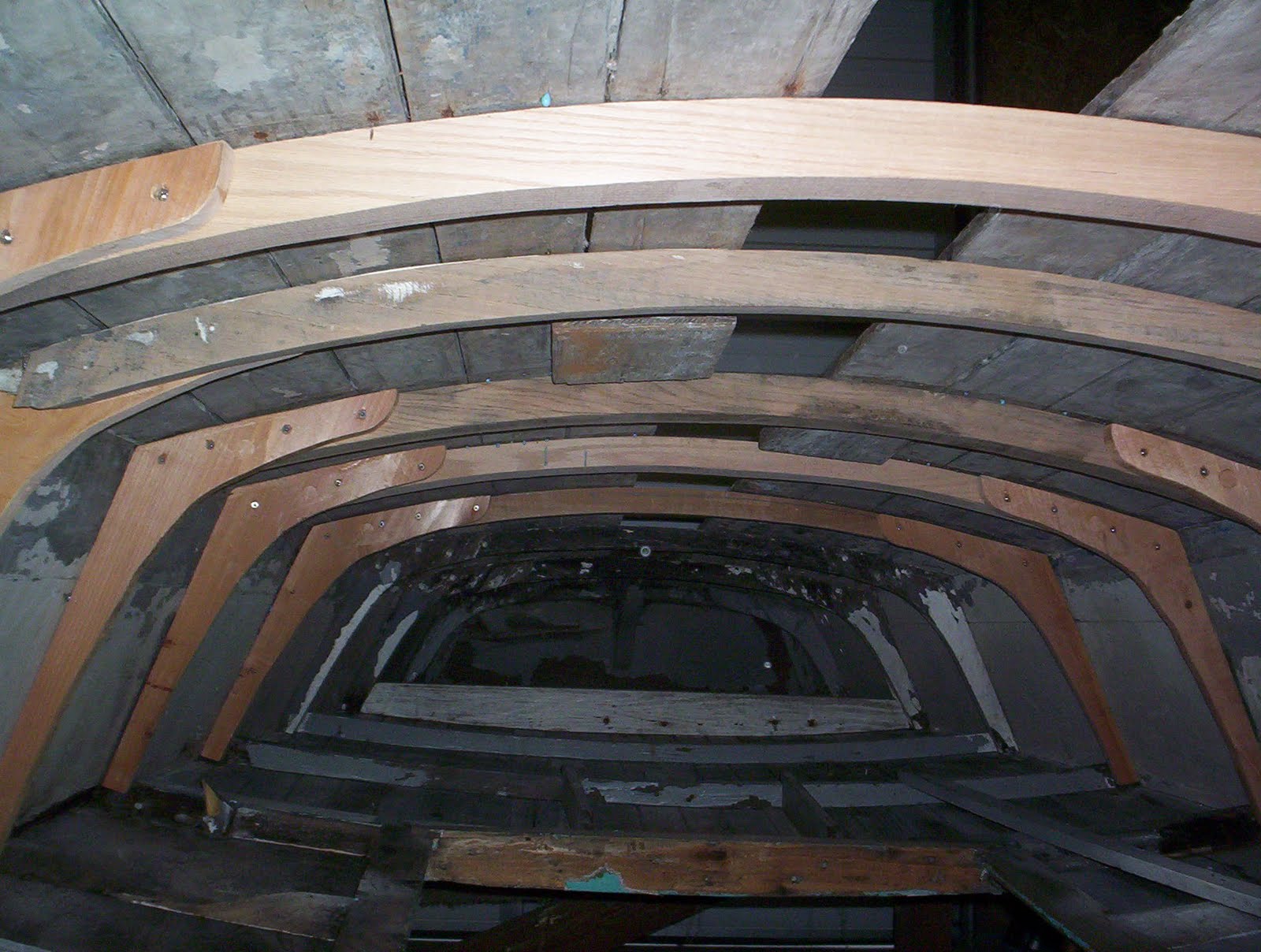
Bill, seeing the advertisement, decided to head to Spokane to see his old friend Alcor. She wasn’t much to look at, but as Bill told of her history the owner realized that she was worth more to Bill than to him, so he gave her to Bill with the understanding she would be restored and raced again. This was a promise Bill could easily keep. It was not a question of if she would be restored; it was only a matter of when. Finally, with all the fleet put to bed for the season, Bill has had a chance to get going on the restoration. About a year after Bill was reunited with Alcor, and 77 years after she was built, she is rising from the ashes to be sailed on Puget Sound again.

With specs from the 1971 Star Log and an original set of plans to guide each step of the restoration, what follows are the messages and pictures that Bill has sent as he has worked on this labor of love. Some of the pictures were taken by Dave Roe as he helped Bill with the restoration. Also, Jim Findley has helped on this project as his wood Star was in Bill’s shop to get a face lift, and no one can resist lending a hand when asked by Bill.


August 17, 2009
I should have the boat all rough sanded this morning and some of the smooth sanding done. I have located all the planks I need for the bottom [Port Orford cedar as specified in the specs] and I will hunt down some oak to finish making the frames I need. It’s possible I could have all the new frames and planks in place by Labor Day weekend. Bill


September 7, 2009
I made and installed five sets of knees and will get the wood to make the other 6 sets tomorrow. I started fairing out the dings in the wood and filled all the screw holes that I’ve uncovered so far. I will still have a bunch when I install the rest of the knees. In the morning I will sand the fairing compound and the hull with the DA, and fill any remaining spots. I will be down at the marina around noon and then go to Hardel’s for my lumber and come home to cut out the rest of the knees, which I will install Wednesday. I hope to finish cleaning out and installing all the wedges in the seams between the bottom planks that will be left in place. All I will have left to do will be to install the new bottom planks and wedge them then I will be ready to fiberglass the bottom and sides to within 2 inches of the gunnels. I will be ready to start on the deck by the beginning of October. Bill


September 13, 2009
I just finished installing the last knee piece and am now ready to start installing the bottom planks that need replacing. I picked up the planks Friday. If I can get my camera working I will take some pictures before installing the bottom planks. I probably won't start on the planks till tomorrow or Tuesday since I need to mow my lawn yet today. I will finish filling the screw holes with fairing compound so I can sand before doing the planks. Bill


September 27, 2009
I finished sanding the bottom tonight, will feather the edge of the glass I put on the bottom. Then I’ll wrap the bottom to side area and put the second layer of the bidirectional cloth at the mast step area. I will be down in the morning to bring some flowers for Hanna. See you or Dave then. Bill


October 2, 2009
I just finished flipping 924 right side up and it is sitting on some tires on the floor. Bill


November 5, 2009
A note to update you on Jim’s and my boat restoration progress. Jim's boat will be ready to put the finish varnish on his deck next Monday or Tuesday. Then he and I will start planking the deck on 924 Monday. It should be completed by next Friday and ready to finish out. I installed the new transom today and glassed the keelson. Tomorrow I will sand and fair the transom into the rest of the hull and put the two part varnish on the keelson. I will also make and install the two cockpit end pieces tomorrow or this weekend so everything will be ready for planking the deck Monday. Bill

November 11, 2009
This picture is showing the deck planked. Now it is just a matter of doing all the screws around the gunnels, plugging the screw holes, sand the edges as well as the deck and it will be ready to finish. Bill


November 18, 2009
Alcor now has a new deck and there is no doubt she will be racing with us in the spring. He has the original wood mast and boom and 1940's era sails for show, but mostly she will be raced in our fleet using the latest hardware and rigging.  Thanks to all of Bill’s work on restoring these forgotten wonders, we have the largest fleet of active racing wood Stars anywhere in the world. There could be 7 boats sailing in the wood division of our fleet including: 924, 2362, 2876, 3331, 4078, 4817, and 4916. Bill tells me there could be a couple of additional wood boats out there that want to join in the fun. I have no doubt the wood division of the Budd Inlet Star Fleet will continue to grow. How could it not, when there is an opportunity to actually race these classic beauties.


For more pictures of the restoration go to the following link:
MORE PICTURES

Sunday, November 8, 2009

Rule 17 Review

One of the limitations in the rules on the right-of-way boat is contained Rule 17, ON THE SAME TACK; PROPER COURSE, which reads as follows:

If a boat clear astern becomes overlapped within two of her hull lengths to leeward of a boat on the same tack, she shall not sail above her proper course while they remain on the same tack and overlapped within that distance, unless in doing so she promptly sails astern of the other boat. This rule does not apply if the overlap begins while the windward boat is required by rule 13 to keep clear.

This rule is in Section B of Part 2, and is put in place so that a boat on the same tack as you can’t establish an overlap to leeward from clear astern and luff you above her proper course. Remember it is the proper course of the boat that has established the overlap to leeward that matters to this rule. Another important point about this rule; if you are a boat that has been overlapped to leeward and believe that the leeward boat is sailing above her proper course, you are still required to keep clear. Your only option is to keep clear and then protest. If you don’t keep clear you will be disqualified even if it is found that the leeward boat did indeed break Rule 17.


I’ll show a couple of cases that demonstrates how the rule works. In the first case a boat on the down wind leg gets an overlap from clear astern and luffs above her proper course, she breaks Rule 17. In the second case two boats are sailing different courses because perhaps they are in a PHRF race and they are different types of boats and sail different angles down wind. In this case even though the windward boat is sailing higher than her proper course it is the proper course of the leeward boat that matters, so Rule 17 is not broken. In the third example before the starting signal you are permitted to establish an overlap to leeward from clear astern and luff head to wind because by the definition of proper course, there is no proper course before the starting signal. However, after the starting signal she needs to head down immediately or she will break Rule 17.

This is the basics of Rule 17. If you want to get more in depth you can review US Sailing Appeals: 4, 13, 43 and 70. Also take a look at ISAF Cases: 7, 13, 14 and 46. If no one protests next month I’ll look at another rule.

Sunday, October 25, 2009

Star Cunningham Rigging

As you might be aware Joe Downing was able to visit with Mark Reynolds who was a Gold Medalist in the Olympics in the Star class. During his visit he was able to pick up some information on how a Gold Medalist rigs the boat. You will find with this post the Reynolds Cunningham. Sherwood has written the the posted paper for your information.

Saturday, October 17, 2009

What It Should Be About

I found this story and it says it all. This is what our sport is all about. Competition without sportsmanship is meaningless.

Megan Six was also recognized by US Sailing as the sailor of the week for her Corinthian spirit.


Sailing Videos on Sailgroove